
— Part 02
How Did SB 623 Become Law in Just One Week?
The Bill Nobody Had Time to Read & How a Veterans’ Property Tax Bill Became One of California’s Most Significant Personal Injury Reform Measures
By Michael Coates, Esq.
— Part 02
How Did SB 623 Become Law in Just One Week
The Bill Nobody Had Time to Read & How a Veterans’ Property Tax Bill Became One of California’s Most Significant Personal Injury Reform Measures
By Michael Coates, Esq.
Watch Michael Coates Read This Article
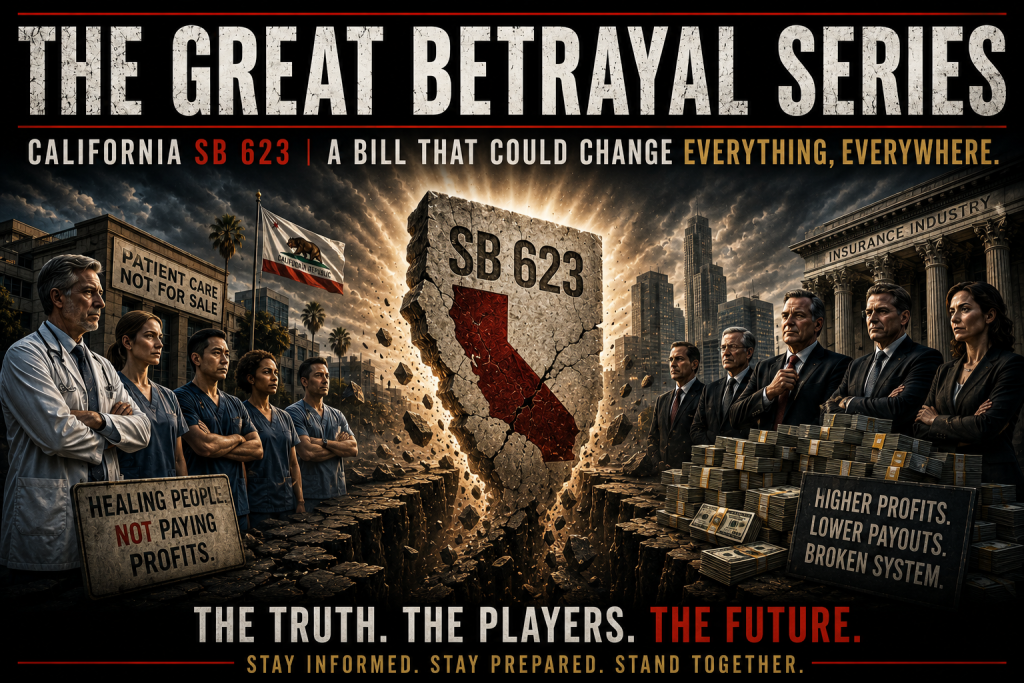
The Great Betrayal
A bill few were meant to read is quietly rewriting who gets paid, who gets protected, and who gets left holding the bill. This is the record of what happened and who it touches next.

The Great Betrayal: Open Mic with Michael Coates
An open mic zoom group discussion on SB 623, the issues and concerns facing healthcare providers, and the potential path forward in California and nationally. Let’s discuss this together. Attendance will be limited so reserve your seat now.
The Great Betrayal
A bill few were meant to read is quietly rewriting who gets paid, who gets protected, and who gets left holding the bill. This is the record of what happened and who it touches next.
The Great Betrayal: Open Mic with Michael Coates
An open mic zoom group discussion on SB 623, the issues and concerns facing healthcare providers, and the potential path forward in California and nationally. Let’s discuss this together. Attendance will be limited so reserve your seat now.
THE GREAT BETRAYAL – PART 2:
How Did SB 623 Become Law in Just One Week
The Bill Nobody Had Time to Read & How a Veterans’ Property Tax Bill Became One of California’s Most Significant Personal Injury Reform Measures
Every law has a story.
Some take years to develop through committee hearings, public debate, expert testimony, and months of legislative refinement. Stakeholders have opportunities to analyze the language, propose amendments, raise concerns, and understand the consequences before a bill becomes law.
Then there are the exceptions.
SB 623 is one of those exceptions.
Regardless of where you stand on its merits, one question deserves to be asked:
How did one of California’s most significant pieces of personal injury legislation become law so quickly, with absolutely no public discussion of its final contents?
For healthcare providers, that question is just as important as the bill itself.
A Bill That Began Somewhere Else
Most providers understandably assume SB 623 began as personal injury legislation.
It didn’t.
The original SB 623 was introduced as veterans’ legislation. Its purpose had nothing to do with medical liens, FAIR Health, attorney referrals, rideshare litigation, medical lien or surgical funding, or personal injury medicine.
Instead, it addressed California property tax exemptions available to qualifying veterans and disabled veterans.
The bill moved through the normal legislative process under that subject matter. It received committee review, legislative votes, and public consideration as a veterans’ property tax measure.
If you had followed SB 623 during most of its legislative life, you would have had no reason to believe it would eventually reshape a portion of California’s personal injury system.
Then Everything Changed
Late in the legislative process, the bill took an entirely different direction.
If you review the voting history on SB 623, you will see it was introduced as a veterans’ property tax exemption. It passed the Senate Standing Committee on Military and Veterans Affairs on January 14, 2026, near the beginning of this year. It then passed the Senate Standing Committee on Revenue and Taxation that same day. It then passed the Senate Standing Committee on Appropriations on January 22nd. And it was passed by the full Senate on January 29th.
From a source who communicated directly with a California State Senator’s Chief of Staff, SB 623, this bill was a repeat bill, getting through the Senate and stalling in the Assembly.
Now we come to June, five months later. On June 3rd, the bill was amended to become the Veterans Bond Act of 2026. On June 16th, it passed the Assembly Standing Committee on Military and Veterans Affairs. Two days later, on June 18th, a few minor amendments were made.
Then, four days later, everything changed. The veteran’s property tax exemption and then bond act was stripped out. The name was changed. The wording was ripped out and completely substituted out. In its place – the compromise between Uber and the Legal Lobby.
Three days later on June 22nd the former veteran’s legislation now rideshare tort reform passed the Assembly Standing Judiciary Committee. Two days later it flew through both the Senate and Assembly as “unfinished business.” That very same day, it was also signed into law by Governor Newsom.
All of this is on the public record, and anyone can access online.
No debate. No committee hearings on the merits. A rush accomplishing an agenda of the Legal Lobby, Uber and the Governor’s Office who rammed it through just in a nick of time.
A nick of time you say? For what? Why?
Because the deadline for an initiative to qualify and be on the official November 2026 ballot was (drum roll please) … June 25th. Yes, the same date it passed both legislative houses and was signed by the Governor.
This legislative technique, often referred to as a “gut-and-amend” process, is a recognized procedure used in California and other legislatures. It allows the contents of an existing bill to be substantially replaced while retaining the bill number.
Its use can significantly shorten the amount of time available for stakeholders to evaluate entirely new policy language before final passage, as was the case here.
That concern is particularly relevant when the replacement language affects an entirely different industry than the bill originally addressed.
Why Timing Matters
Healthcare providers and physicians are busy.
They’re treating patients. Running practices. Managing staff. Dealing with insurance issues. Documenting care. Negotiating with law firms and insurers to get paid.
Most physicians and providers are not monitoring the California legislative calendar every day looking for last-minute amendments to bills that previously dealt with veterans’ property tax exemptions.
Why would they?
That is why timing matters.
Meaningful participation in the legislative process depends on meaningful notice.
The shorter the time between major amendments and enactment, the less opportunity affected industries have to analyze the proposal, educate members, identify unintended consequences, or recommend improvements.
Whether one supports or opposes SB 623, it is fair to recognize that many if not all providers and physicians first learned of its final form only after it had already become law.
The Political Context
SB 623 did not emerge in a vacuum.
California was simultaneously facing competing ballot initiatives involving rideshare companies and the plaintiffs’ bar.
Those initiatives carried substantial financial and political consequences.
One proposal would have significantly affected attorney contingency fees in certain covered cases. The Uber ballot initiative sought to limit attorneys’ fees to 25% from the normal 33% to 60%. Some would argue that putting a lower cap on attorney’s fees is long overdue, as many law firms and attorneys gobble up the majority of personal injury settlements to the detriment of their own clients in many cases, and more often, healthcare providers.
Another ballot initiative, by the Legal Lobby in response to Uber’s initiative, addressed safety and litigation issues involving transportation network companies.
At the same time, Governor Newsome, as most Governors during election time, had other ballot initiatives he wanted voters to focus on and pass.
Rather than allowing voters to resolve competing initiatives at the ballot box and taking focus away from the Governor’s political priorities, negotiations produced a legislative compromise.
SB 623 became the vehicle through which that compromise was implemented.
Compromise is a normal part of politics.
Nearly every significant piece of legislation reflects negotiation.
The important question is not whether compromise occurred.
The important question is how the resulting compromise allocates benefits, responsibilities, and risks among the various stakeholders.
That is where healthcare providers should focus their attention. Because while not being at the legislative table, their rights and those of their patients were being directly impacted.
Reading Beyond the Headlines
Media coverage understandably focused on the political victory.
The competing ballot initiatives were withdrawn. The legislative battle ended. The compromise was reached. Harmony between competing factions came to an end. And a Governor with his sight on the White House had a chance to shift the political focus and claim a win for tort reform.
Those are newsworthy developments.
But headlines rarely explain operational consequences.
Healthcare providers need to know something entirely different:
What will this mean for my practice?
Will it affect my billing?
Will it change my documentation?
Will I need new intake procedures?
Will it affect patients’ access to treatment?
Will it expose me to increased professional or personal liability?
Will I be able to get insurance to cover any new exposures?
Will it influence whether I continue accepting lien cases?
Those questions cannot be answered by reading political headlines.
They require reading the statutory language itself.
The Legislative Process Versus the Practical Process
The legislative process determines how a bill becomes law. The practical process determines how that law changes daily life. Those are two different conversations.
For healthcare providers, the second conversation is the one that matters most.
If a new law changes reimbursement expectations… …changes documentation obligations… …creates new declaration requirements… …affects lien financing… …or alters litigation strategy… those operational consequences deserve careful attention regardless of how the legislation reached the Governor’s desk.
The law is now part of the legal and healthcare office compliance landscape.
Understanding it is no longer optional.
What Providers & Physicians Should Learn From This Experience
SB 623 offers a broader lesson that extends well beyond this particular statute.
Healthcare providers and physicians cannot afford to become involved in public policy only after legislation is enacted.
By then, the opportunity to influence language has largely passed.
That does not mean every physician needs to become a lobbyist.
It does mean providers should:
Laws governing healthcare increasingly affect not only reimbursement, but also documentation, compliance, patient access to care, litigation, and practice management.
Remaining informed is becoming part of practicing medicine.
Looking Ahead
Whether SB 623 ultimately proves to be successful reform or a source of unintended consequences remains to be seen.
Reasonable people will disagree. Courts will interpret portions of the statute. Providers will adapt. Attorneys will adjust litigation strategies. Patients will experience whatever practical effects follow.
But one thing should unite everyone involved: Good legislation benefits from informed discussion before implementation, not after.
Healthcare providers and physicians deserve the opportunity to understand laws that significantly affect their practices.
Patients deserve confidence that changes in public policy will preserve access to quality care.
And legislators benefit when those most directly affected by proposed laws have meaningful opportunities to contribute their expertise and the projected impact of proposed legislation.
THE GREAT BETRAYAL – PART 2:
How Did SB 623 Become Law in Just One Week
The Bill Nobody Had Time to Read & How a Veterans’ Property Tax Bill Became One of California’s Most Significant Personal Injury Reform Measures
Every law has a story.
Some take years to develop through committee hearings, public debate, expert testimony, and months of legislative refinement. Stakeholders have opportunities to analyze the language, propose amendments, raise concerns, and understand the consequences before a bill becomes law.
Then there are the exceptions.
SB 623 is one of those exceptions.
Regardless of where you stand on its merits, one question deserves to be asked:
How did one of California’s most significant pieces of personal injury legislation become law so quickly, with absolutely no public discussion of its final contents?
For healthcare providers, that question is just as important as the bill itself.
A Bill That Began Somewhere Else
Most providers understandably assume SB 623 began as personal injury legislation.
It didn’t.
The original SB 623 was introduced as veterans’ legislation. Its purpose had nothing to do with medical liens, FAIR Health, attorney referrals, rideshare litigation, medical lien or surgical funding, or personal injury medicine.
Instead, it addressed California property tax exemptions available to qualifying veterans and disabled veterans.
The bill moved through the normal legislative process under that subject matter. It received committee review, legislative votes, and public consideration as a veterans’ property tax measure.
If you had followed SB 623 during most of its legislative life, you would have had no reason to believe it would eventually reshape a portion of California’s personal injury system.
Then Everything Changed
Late in the legislative process, the bill took an entirely different direction.
If you review the voting history on SB 623, you will see it was introduced as a veterans’ property tax exemption. It passed the Senate Standing Committee on Military and Veterans Affairs on January 14, 2026, near the beginning of this year. It then passed the Senate Standing Committee on Revenue and Taxation that same day. It then passed the Senate Standing Committee on Appropriations on January 22nd. And it was passed by the full Senate on January 29th.
From a source who communicated directly with a California State Senator’s Chief of Staff, SB 623, this bill was a repeat bill, getting through the Senate and stalling in the Assembly.
Now we come to June, five months later. On June 3rd, the bill was amended to become the Veterans Bond Act of 2026. On June 16th, it passed the Assembly Standing Committee on Military and Veterans Affairs. Two days later, on June 18th, a few minor amendments were made.
Then, four days later, everything changed. The veteran’s property tax exemption and then bond act was stripped out. The name was changed. The wording was ripped out and completely substituted out. In its place – the compromise between Uber and the Legal Lobby.
Three days later on June 22nd the former veteran’s legislation now rideshare tort reform passed the Assembly Standing Judiciary Committee. Two days later it flew through both the Senate and Assembly as “unfinished business.” That very same day, it was also signed into law by Governor Newsom.
All of this is on the public record, and anyone can access online.
No debate. No committee hearings on the merits. A rush accomplishing an agenda of the Legal Lobby, Uber and the Governor’s Office who rammed it through just in a nick of time.
A nick of time you say? For what? Why?
Because the deadline for an initiative to qualify and be on the official November 2026 ballot was (drum roll please) … June 25th. Yes, the same date it passed both legislative houses and was signed by the Governor.
This legislative technique, often referred to as a “gut-and-amend” process, is a recognized procedure used in California and other legislatures. It allows the contents of an existing bill to be substantially replaced while retaining the bill number.
Its use can significantly shorten the amount of time available for stakeholders to evaluate entirely new policy language before final passage, as was the case here.
That concern is particularly relevant when the replacement language affects an entirely different industry than the bill originally addressed.
Why Timing Matters
Healthcare providers and physicians are busy.
They’re treating patients. Running practices. Managing staff. Dealing with insurance issues. Documenting care. Negotiating with law firms and insurers to get paid.
Most physicians and providers are not monitoring the California legislative calendar every day looking for last-minute amendments to bills that previously dealt with veterans’ property tax exemptions.
Why would they?
That is why timing matters.
Meaningful participation in the legislative process depends on meaningful notice.
The shorter the time between major amendments and enactment, the less opportunity affected industries have to analyze the proposal, educate members, identify unintended consequences, or recommend improvements.
Whether one supports or opposes SB 623, it is fair to recognize that many if not all providers and physicians first learned of its final form only after it had already become law.
The Political Context
SB 623 did not emerge in a vacuum.
California was simultaneously facing competing ballot initiatives involving rideshare companies and the plaintiffs’ bar.
Those initiatives carried substantial financial and political consequences.
One proposal would have significantly affected attorney contingency fees in certain covered cases. The Uber ballot initiative sought to limit attorneys’ fees to 25% from the normal 33% to 60%. Some would argue that putting a lower cap on attorney’s fees is long overdue, as many law firms and attorneys gobble up the majority of personal injury settlements to the detriment of their own clients in many cases, and more often, healthcare providers.
Another ballot initiative, by the Legal Lobby in response to Uber’s initiative, addressed safety and litigation issues involving transportation network companies.
At the same time, Governor Newsome, as most Governors during election time, had other ballot initiatives he wanted voters to focus on and pass.
Rather than allowing voters to resolve competing initiatives at the ballot box and taking focus away from the Governor’s political priorities, negotiations produced a legislative compromise.
SB 623 became the vehicle through which that compromise was implemented.
Compromise is a normal part of politics.
Nearly every significant piece of legislation reflects negotiation.
The important question is not whether compromise occurred.
The important question is how the resulting compromise allocates benefits, responsibilities, and risks among the various stakeholders.
That is where healthcare providers should focus their attention. Because while not being at the legislative table, their rights and those of their patients were being directly impacted.
Reading Beyond the Headlines
Media coverage understandably focused on the political victory.
The competing ballot initiatives were withdrawn. The legislative battle ended. The compromise was reached. Harmony between competing factions came to an end. And a Governor with his sight on the White House had a chance to shift the political focus and claim a win for tort reform.
Those are newsworthy developments.
But headlines rarely explain operational consequences.
Healthcare providers need to know something entirely different:
What will this mean for my practice?
Will it affect my billing?
Will it change my documentation?
Will I need new intake procedures?
Will it affect patients’ access to treatment?
Will it expose me to increased professional or personal liability?
Will I be able to get insurance to cover any new exposures?
Will it influence whether I continue accepting lien cases?
Those questions cannot be answered by reading political headlines.
They require reading the statutory language itself.
The Legislative Process Versus the Practical Process
The legislative process determines how a bill becomes law. The practical process determines how that law changes daily life. Those are two different conversations.
For healthcare providers, the second conversation is the one that matters most.
If a new law changes reimbursement expectations… …changes documentation obligations… …creates new declaration requirements… …affects lien financing… …or alters litigation strategy… those operational consequences deserve careful attention regardless of how the legislation reached the Governor’s desk.
The law is now part of the legal and healthcare office compliance landscape.
Understanding it is no longer optional.
What Providers & Physicians Should Learn From This Experience
SB 623 offers a broader lesson that extends well beyond this particular statute.
Healthcare providers and physicians cannot afford to become involved in public policy only after legislation is enacted.
By then, the opportunity to influence language has largely passed.
That does not mean every physician needs to become a lobbyist.
It does mean providers should:
Laws governing healthcare increasingly affect not only reimbursement, but also documentation, compliance, patient access to care, litigation, and practice management.
Remaining informed is becoming part of practicing medicine.
Looking Ahead
Whether SB 623 ultimately proves to be successful reform or a source of unintended consequences remains to be seen.
Reasonable people will disagree. Courts will interpret portions of the statute. Providers will adapt. Attorneys will adjust litigation strategies. Patients will experience whatever practical effects follow.
But one thing should unite everyone involved: Good legislation benefits from informed discussion before implementation, not after.
Healthcare providers and physicians deserve the opportunity to understand laws that significantly affect their practices.
Patients deserve confidence that changes in public policy will preserve access to quality care.
And legislators benefit when those most directly affected by proposed laws have meaningful opportunities to contribute their expertise and the projected impact of proposed legislation.
THE GREAT BETRAYAL – Part 3
SB 623 Explained and 9 Changes Every Healthcare Provider Needs to Understand
The Great Betrayal
A bill few were meant to read is quietly rewriting who gets paid, who gets protected, and who gets left holding the bill. This is the record of what happened and who it touches next.
The Great Betrayal: Open Mic with Michael Coates
An open mic zoom group discussion on SB 623, the issues and concerns facing healthcare providers, and the potential path forward in California and nationally. Let’s discuss this together. Attendance will be limited so reserve your seat now.
THE GREAT BETRAYAL – Part 3
SB 623 Explained and 9 Changes Every Healthcare Provider Needs to Understand
The Great Betrayal
A bill few were meant to read is quietly rewriting who gets paid, who gets protected, and who gets left holding the bill. This is the record of what happened and who it touches next.
The Great Betrayal: Open Mic with Michael Coates
An open mic zoom group discussion on SB 623, the issues and concerns facing healthcare providers, and the potential path forward in California and nationally. Let’s discuss this together. Attendance will be limited so reserve your seat now.
The next chapter names more players and more states. Get every part the moment it publishes, and let your professional organizations, state associations, and legislators hear your voice.
The next chapter names more players and more states. Get every part the moment it publishes, and let your professional organizations, state associations, and legislators hear your voice.
— WHAT COMES NEXT
Knowing what changed is only the beginning
The Great Betrayal lays out the story, the law, and the risk. What you do with that information next could shape how your practice protects care and payment.
PI Billing Pros
When difficult law firms push back, hand off those law firms and let the experts handle your negotiations.
Business Advantage Coaching
Build a stronger personal injury practice before difficult law firms and lowball offers put your practice at risk.
— WHAT COMES NEXT
Knowing what changed is only the beginning
The Great Betrayal lays out the story, the law, and the risk. What you do with that information next could shape how your practice protects care and payment.
PI Billing Pros
When difficult law firms push back, hand off those law firms and let the experts handle your negotiations.
Business Advantage Coaching
Build a stronger personal injury practice before difficult law firms and lowball offers put your practice at risk.
Secure your seat today. Choose the discussion topic that interests you and join our Open Mic Zoom conversation on the issues impacting healthcare providers. Attendance is limited.
We’ll only use this to confirm your reservation and send event updates.