
— Part 04
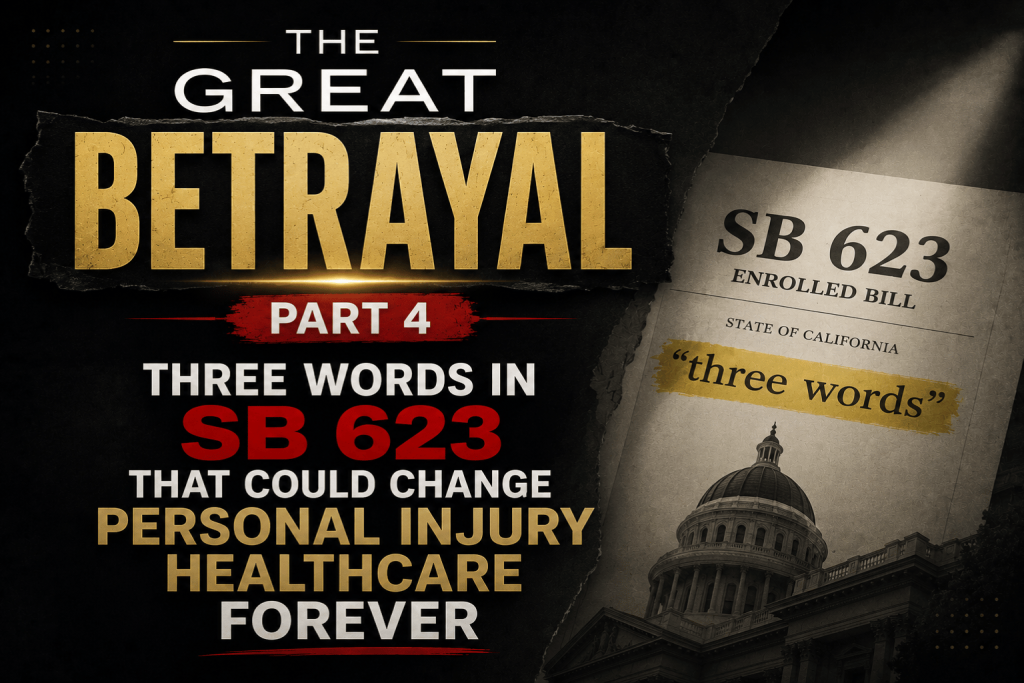
Three Words in SB 623 That Could Change Personal Injury Healthcare Forever
How “Void and Unenforceable” May Change Decisions Long Before a Case Ever Reaches Court
By Michael Coates, Esq.
— Part 04
Three Words in SB 623 That Could Change Personal Injury Healthcare Forever
How “Void and Unenforceable” May Change Decisions Long Before a Case Ever Reaches Court
By Michael Coates, Esq.
Watch Michael Coates Read This Article
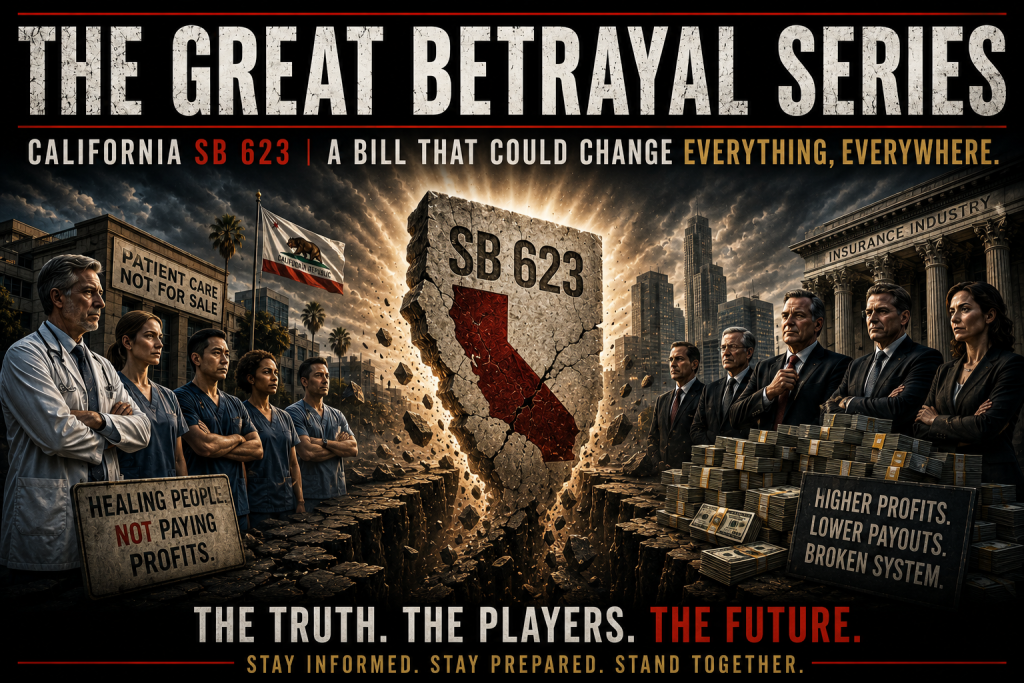
The Great Betrayal
A bill few were meant to read is quietly rewriting who gets paid, who gets protected, and who gets left holding the bill. This is the record of what happened and who it touches next.

The Great Betrayal: Open Mic with Michael Coates
An open mic zoom group discussion on SB 623, the issues and concerns facing healthcare providers, and the potential path forward in California and nationally. Let’s discuss this together. Attendance will be limited so reserve your seat now.
The Great Betrayal
A bill few were meant to read is quietly rewriting who gets paid, who gets protected, and who gets left holding the bill. This is the record of what happened and who it touches next.
The Great Betrayal: Open Mic with Michael Coates
An open mic zoom group discussion on SB 623, the issues and concerns facing healthcare providers, and the potential path forward in California and nationally. Let’s discuss this together. Attendance will be limited so reserve your seat now.
THE GREAT BETRAYAL – PART 4:
Three Words in SB 623 That Could Change Personal Injury Healthcare Forever
How “Void and Unenforceable” May Change Decisions Long Before a Case Ever Reaches Court
Most people assume laws change outcomes in court.
Sometimes they do. But more often, laws change something far more powerful.
They change behavior.
A physician changes the patients they accept. A surgery center changes the cases it will schedule. A lender changes what it will finance. An attorney changes the cases it is willing to pursue.
And ultimately…
A patient discovers that the healthcare they assumed would be available simply isn’t.
That is why, in my opinion, the three most important words contained in California’s SB 623 are not “FAIR Health.” They are not “Transportation Network Company.” They are not “70th Percentile.”
They are three simple words that many providers may have overlooked.
“Void and unenforceable.”
Those three words may fundamentally change how healthcare providers evaluate risk before treatment ever begins.
It Isn’t About Winning a Lawsuit
One misconception I’ve already heard is this: Well…this only affects what happens after the case settles right?
I don’t believe that’s the right question.
The real question is much earlier: Will the patient ever receive treatment in the first place?
Every healthcare provider makes business decisions every day.
Can I hire another employee? Can I buy another imaging machine? Can I expand my office? Can I continue taking Medicare? Can I continue treating workers’ compensation patients?
SB 623 introduces another question: Should I continue treating lien-based rideshare lien patients?
Notice…
That question isn’t asked in court. It’s asked before the patient is even scheduled to visit your office.
Meet John
John is forty-two years old. He’s driving home from work when an Uber driver runs a red light.
His knee strikes the dashboard. The MRI is positive. His orthopedic surgeon tells him surgery is medically necessary.
John has no health insurance. He doesn’t have $35,000 sitting in his savings account.
Without lien treatment, there is no surgery option for him.
Now let’s step into the surgeon’s office.
The surgeon isn’t asking whether John deserves surgery. He clearly does.
The surgeon is asking a different question: Should I take on this patient because he is a rideshare crash case wanting treatment on a lien basis?
That is the question SB 623 may influence.
The Financial Equation Has Changed
Before SB 623, accepting a lien case certainly involved risk.
Providers often wait months, or years, for payment.
Negotiations are common. Reductions occur. Some bills are never fully paid. And some are not paid at all.
None of that is new. Healthcare providers understood the pre-SB 623 personal injury patient business. They accepted the risk because many believed two things:
First… Patients deserved care.
Second… The legal system generally recognized that providers accepting lien cases assumed extraordinary financial risk.
SB 623 changes portions of that equation.
When providers begin reading language discussing statutory benchmarks, financing limitations, and bills declared “void and unenforceable,” many will naturally reassess how much risk they are willing to assume.
The patient hasn’t changed. The injury hasn’t changed. The procedure hasn’t changed.
The risk analysis has changed. Solely because the patient was involved in a rideshare car crash.
Now Walk Into the Surgery Center
An ambulatory surgery center (ASC) receives John’s case.
The procedure requires:
The ASC may have tens of thousands of dollars invested before receiving a single dollar in payment.
The administrator now asks: Can we afford this risk?
More importantly… Can we continue accepting these cases if medical funding becomes significantly more difficult or cut out altogether?
That question has nothing to do with compassion. It has everything to do with business survival.
Healthcare providers and physicians and the facilities where procedures take place cannot continue helping patients if financial realities eventually create a risk that they will have to close their doors.
What About Medical Funding?
One provision of SB 623 receiving comparatively little public attention is its impact on medical lien financing and assignments.
Many people outside the personal injury industry do not understand why medical funding exists.
The answer is simple: Personal injury healthcare often requires providers to wait months or years before payment.
Surgeries. Pain relief procedures. Advanced imaging. Specialty consultations. Those services can be expensive.
Funding companies provide liquidity. They allow physicians, medical providers, and facilities to continue delivering care while assuming part of the financial risk.
Critics argue that some funding arrangements create unnecessary costs or distort incentives. Those concerns deserve discussion.
But providers should also ask another question: If funding becomes economically impractical… who assumes the risk?
In many cases…
No one. The funding disappears. The provider declines the case. The patient waits or goes untreated.
The Neurosurgeon
Now imagine something more serious.
A patient suffers severe cervical instability requiring serious spinal surgery.
No insurance. No cash. No funding.
Should the neurosurgeon proceed? Should the surgery center? Should manufacturers of medical equipment extend credit?
Every participant in the chain asks essentially the same question: Who is carrying the financial risk?
The answer to that question increasingly determines whether care happens at all.
The Silent Decision Patients Never See
Patients rarely hear the conversation related above.
They simply call an office: “I’m sorry. We no longer accept those cases.”
They call another office: “I’m sorry.”
Another: “I’m sorry.”
Eventually… Some patients stop calling.
From their perspective, nothing about SB 623 caused the problem. All they know is they cannot find someone willing to help.
That is how legislation changes healthcare. Not always by prohibiting treatment. But by influencing the willingness of good providers to assume financial uncertainty and removing options.
Some might say the attorney will find a provider who can do it.
But wait, now all referrals from law firms must be disclose, so the defense can challenge that a procedure was not medically necessary and is just attorney-directed care.
So in the post-SB 623 world, at least rideshare patients will more and more need to locate a provider willing to take on the risk of medically necessary care on their own. Will they?
This Is Why Access to Care Matters
Throughout this debate, discussions often focus on reimbursement. Or litigation. Or billing.
Those topics matter. But they should never overshadow the central issue: Patient access to needed medical care.
Every personal injury patient deserves timely, appropriate, medically necessary care.
If reforms improve transparency… Good.
If reforms reduce fraud… Great.
If reforms eliminate unethical conduct… Excellent.
But every reform should also be measured against one additional question: Will patients still receive the care they need when they need it?
That question deserves equal consideration.
Behavior Is the Real Story
Laws rarely tell physicians: “Do not operate.”
Instead… They influence incentives. Those incentives influence decisions. Those decisions influence patient care.
That is why healthcare providers should study SB 623 carefully.
Not because every consequence is already known. Not because every prediction will prove correct. But because every significant legislative change alters how rational people evaluate risk.
Providers, physicians and surgical facilities are not simply healthcare professionals. They are also business owners.
Surgery centers manage cash flow. Physicians employ staff. Practices purchase equipment.
Every business evaluates risk. And SB 623 changes that conversation.
Exactly how much remains to be seen. But pretending the conversation will not change would ignore how healthcare economics work.
The Question Every Provider Must Ask
Perhaps the most important question raised by SB 623 is not: What happens after settlement?
Perhaps it is this: Will good healthcare providers still be willing and financially able to accept these patients in the first place?
Or will rideshare patients and later I believe all personal injury patients be left to less-desirable healthcare providers.
Because if the answer to that question begins changing…
Everything else changes with it.
THE GREAT BETRAYAL – PART 4:
Three Words in SB 623 That Could Change Personal Injury Healthcare Forever
How “Void and Unenforceable” May Change Decisions Long Before a Case Ever Reaches Court
Most people assume laws change outcomes in court.
Sometimes they do. But more often, laws change something far more powerful.
They change behavior.
A physician changes the patients they accept. A surgery center changes the cases it will schedule. A lender changes what it will finance. An attorney changes the cases it is willing to pursue.
And ultimately…
A patient discovers that the healthcare they assumed would be available simply isn’t.
That is why, in my opinion, the three most important words contained in California’s SB 623 are not “FAIR Health.” They are not “Transportation Network Company.” They are not “70th Percentile.”
They are three simple words that many providers may have overlooked.
“Void and unenforceable.”
Those three words may fundamentally change how healthcare providers evaluate risk before treatment ever begins.
It Isn’t About Winning a Lawsuit
One misconception I’ve already heard is this: Well…this only affects what happens after the case settles right?
I don’t believe that’s the right question.
The real question is much earlier: Will the patient ever receive treatment in the first place?
Every healthcare provider makes business decisions every day.
Can I hire another employee? Can I buy another imaging machine? Can I expand my office? Can I continue taking Medicare? Can I continue treating workers’ compensation patients?
SB 623 introduces another question: Should I continue treating lien-based rideshare lien patients?
Notice…
That question isn’t asked in court. It’s asked before the patient is even scheduled to visit your office.
Meet John
John is forty-two years old. He’s driving home from work when an Uber driver runs a red light.
His knee strikes the dashboard. The MRI is positive. His orthopedic surgeon tells him surgery is medically necessary.
John has no health insurance. He doesn’t have $35,000 sitting in his savings account.
Without lien treatment, there is no surgery option for him.
Now let’s step into the surgeon’s office.
The surgeon isn’t asking whether John deserves surgery. He clearly does.
The surgeon is asking a different question: Should I take on this patient because he is a rideshare crash case wanting treatment on a lien basis?
That is the question SB 623 may influence.
The Financial Equation Has Changed
Before SB 623, accepting a lien case certainly involved risk.
Providers often wait months, or years, for payment.
Negotiations are common. Reductions occur. Some bills are never fully paid. And some are not paid at all.
None of that is new. Healthcare providers understood the pre-SB 623 personal injury patient business. They accepted the risk because many believed two things:
First… Patients deserved care.
Second… The legal system generally recognized that providers accepting lien cases assumed extraordinary financial risk.
SB 623 changes portions of that equation.
When providers begin reading language discussing statutory benchmarks, financing limitations, and bills declared “void and unenforceable,” many will naturally reassess how much risk they are willing to assume.
The patient hasn’t changed. The injury hasn’t changed. The procedure hasn’t changed.
The risk analysis has changed. Solely because the patient was involved in a rideshare car crash.
Now Walk Into the Surgery Center
An ambulatory surgery center (ASC) receives John’s case.
The procedure requires:
The ASC may have tens of thousands of dollars invested before receiving a single dollar in payment.
The administrator now asks: Can we afford this risk?
More importantly… Can we continue accepting these cases if medical funding becomes significantly more difficult or cut out altogether?
That question has nothing to do with compassion. It has everything to do with business survival.
Healthcare providers and physicians and the facilities where procedures take place cannot continue helping patients if financial realities eventually create a risk that they will have to close their doors.
What About Medical Funding?
One provision of SB 623 receiving comparatively little public attention is its impact on medical lien financing and assignments.
Many people outside the personal injury industry do not understand why medical funding exists.
The answer is simple: Personal injury healthcare often requires providers to wait months or years before payment.
Surgeries. Pain relief procedures. Advanced imaging. Specialty consultations. Those services can be expensive.
Funding companies provide liquidity. They allow physicians, medical providers and facilities to continue delivering care while assuming part of the financial risk.
Critics argue that some funding arrangements create unnecessary costs or distort incentives. Those concerns deserve discussion.
But providers should also ask another question: If funding becomes economically impractical…who assumes the risk?
In many cases…
No one. The funding disappears. The provider declines the case. The patient waits or goes untreated.
The Neurosurgeon
Now imagine something more serious.
A patient suffers severe cervical instability requiring serious spinal surgery.
No insurance. No cash. No funding.
Should the neurosurgeon proceed? Should the surgery center? Should manufacturers of medical equipment extend credit?
Every participant in the chain asks essentially the same question: Who is carrying the financial risk?
The answer to that question increasingly determines whether care happens at all.
The Silent Decision Patients Never See
Patients rarely hear the conversation related above.
They simply call an office: “I’m sorry. We no longer accept those cases.”
They call another office: “I’m sorry.”
Another: “I’m sorry.”
Eventually… Some patients stop calling.
From their perspective, nothing about SB 623 caused the problem. All they know is they cannot find someone willing to help.
That is how legislation changes healthcare. Not always by prohibiting treatment. But by influencing the willingness of good providers to assume financial uncertainty and removing options.
Some might say the attorney will find a provider who can do it.
But wait, now all referrals from law firms must be disclosed so the defense can challenge that a procedure was not medically necessary and is just attorney-directed care.
So in the post-SB 623 world, at least rideshare patients will more and more need to locate a provider willing to take on the risk of medically necessary care on their own. Will they?
This Is Why Access to Care Matters
Throughout this debate, discussions often focus on reimbursement. Or litigation. Or billing.
Those topics matter. But they should never overshadow the central issue: Patient access to needed medical care.
Every personal injury patient deserves timely, appropriate, medically necessary care.
If reforms improve transparency… Good.
If reforms reduce fraud… Great.
If reforms eliminate unethical conduct… Excellent.
But every reform should also be measured against one additional question: Will patients still receive the care they need when they need it when they need it?
That question deserves equal consideration.
Behavior Is the Real Story
Laws rarely tell physicians: “Do not operate.”
Instead…They influence incentives. Those incentives influence decisions. Those decisions influence patient care.
That is why healthcare providers should study SB 623 carefully.
Not because every consequence is already known. Not because every prediction will prove correct. But because every significant legislative change alters how rational people evaluate risk.
Providers and physicians and surgical facilities are not simply healthcare professionals. They are also business owners.
Surgery centers manage cash flow. Physicians employ staff. Practices purchase equipment.
Every business evaluates risk. And SB 623 changes that conversation.
Exactly how much remains to be seen. But pretending the conversation will not change would ignore how healthcare economics work.
The Question Every Provider Must Ask
Perhaps the most important question raised by SB 623 is not: What happens after settlement?
Perhaps it is this: Will good healthcare providers still be willing, and financially able, to accept these patients in the first place?
Or will rideshare patients and later I believe all personal injury patients be left to less-desirable healthcare providers.
Because if the answer to that question begins changing…
Everything else changes with it.
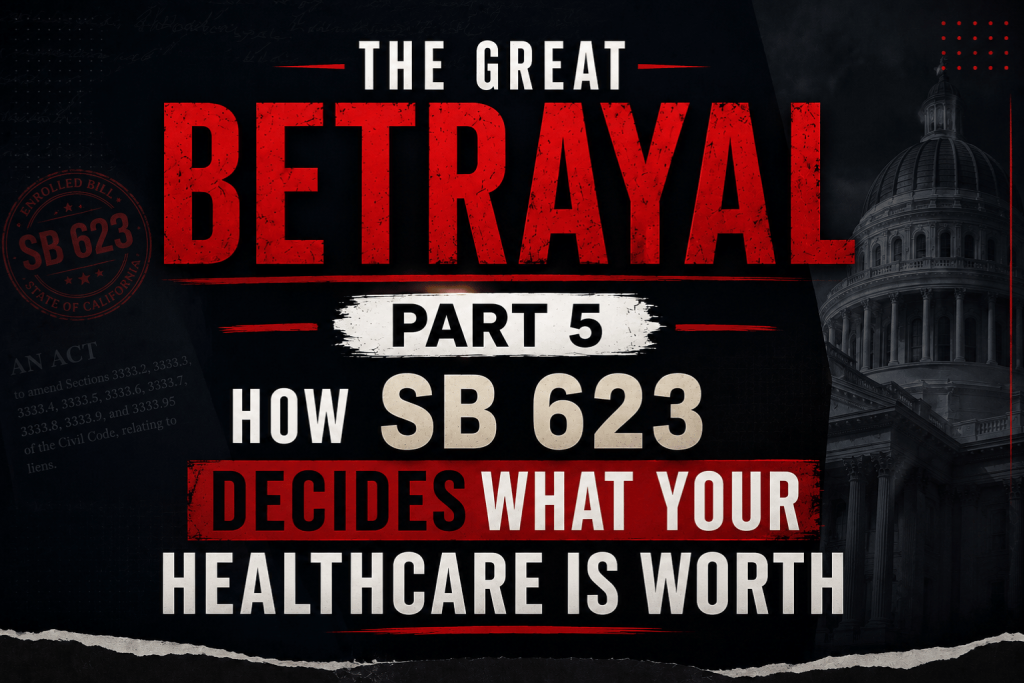
THE GREAT BETRAYAL – Part 5
How SB 623 Decides What Your Healthcare Is Worth
The Great Betrayal
A bill few were meant to read is quietly rewriting who gets paid, who gets protected, and who gets left holding the bill. This is the record of what happened and who it touches next.
The Great Betrayal: Open Mic with Michael Coates
An open mic zoom group discussion on SB 623, the issues and concerns facing healthcare providers, and the potential path forward in California and nationally. Let’s discuss this together. Attendance will be limited so reserve your seat now.
THE GREAT BETRAYAL – Part 5
How SB 623 Decides What Your Healthcare Is Worth
The Great Betrayal
A bill few were meant to read is quietly rewriting who gets paid, who gets protected, and who gets left holding the bill. This is the record of what happened and who it touches next.
The Great Betrayal: Open Mic with Michael Coates
An open mic zoom group discussion on SB 623, the issues and concerns facing healthcare providers, and the potential path forward in California and nationally. Let’s discuss this together. Attendance will be limited so reserve your seat now.
The next chapter names more players and more states. Get every part the moment it publishes, and let your professional organizations, state associations, and legislators hear your voice.
The next chapter names more players and more states. Get every part the moment it publishes, and let your professional organizations, state associations, and legislators hear your voice.
— WHAT COMES NEXT
Knowing what changed is only the beginning
The Great Betrayal lays out the story, the law, and the risk. What you do with that information next could shape how your practice protects care and payment.
PI Billing Pros
When difficult law firms push back, hand off those law firms and let the experts handle your negotiations.
Business Advantage Coaching
Build a stronger personal injury practice before difficult law firms and lowball offers put your practice at risk.
— WHAT COMES NEXT
Knowing what changed is only the beginning
The Great Betrayal lays out the story, the law, and the risk. What you do with that information next could shape how your practice protects care and payment.
PI Billing Pros
When difficult law firms push back, hand off those law firms and let the experts handle your negotiations.
Business Advantage Coaching
Build a stronger personal injury practice before difficult law firms and lowball offers put your practice at risk.
Secure your seat today. Choose the discussion topic that interests you and join our Open Mic Zoom conversation on the issues impacting healthcare providers. Attendance is limited.
We’ll only use this to confirm your reservation and send event updates.