
How Medical Providers Are Being Misled About Tort Reform
Tort Reform May Reshape Personal Injury (PI), But Not Ruin It -- And May Even Save It
Tort reform is sweeping the country. And while the plaintiff’s bar is sounding alarms and shouting “the sky is falling,” medical providers need to hear a very different message, because the truth is not what you’re being told. This movement isn’t new. It has existed for decades.
But in recent years, tort reform has accelerated. Here’s just a few and more are contemplating tort reform right now:
- 2022 – Arizona: mandatory lien negotiations
- 2023 – Florida: property-damage abuse reforms spilling into PI
- Georgia & Utah: elimination of the collateral source rule, allowing actual payments—not billed charges—to come into evidence
The next battleground is California, with the most aggressive proposal yet. It will be the place of the greatest concentration by law firms and attorneys in PI than ever existed before.
Uber is backing a ballot initiative to:
- Eliminate the collateral source rule, and
- Cap plaintiff attorney fees at 25%
The plaintiff’s bar is furious.
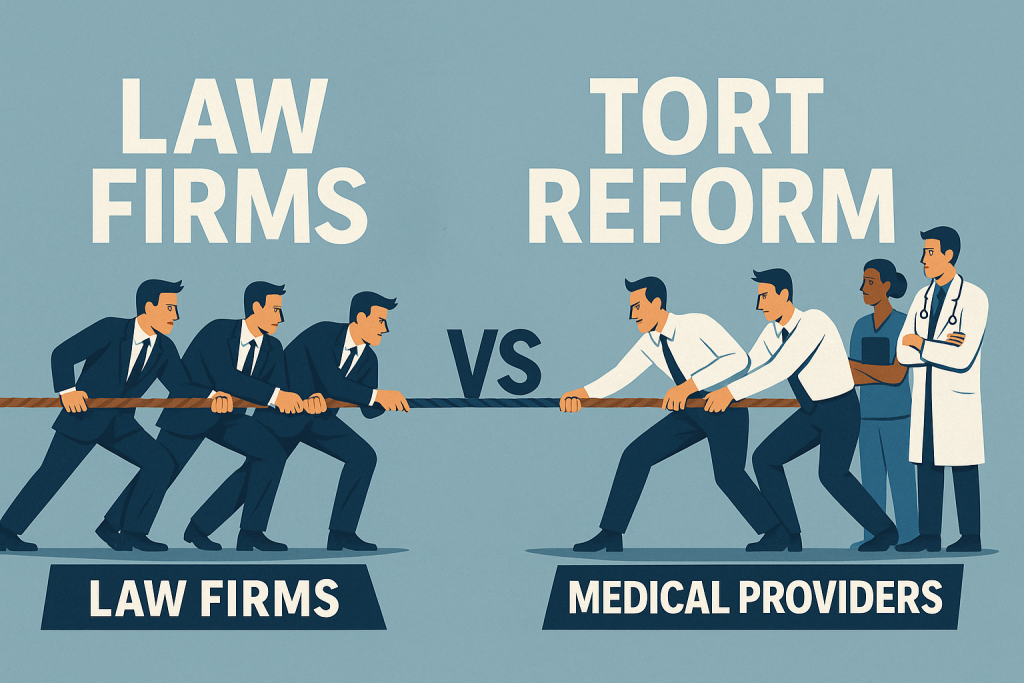
And now, the same legal organizations and law firms who reduce, pressure, and squeeze medical providers are suddenly running to providers saying: “The sky is falling. Stand with us! Lobby with us! Donate money!”
Strange timing, isn’t it?
These are the same firms that have earned millions, the reason tort reform gained momentum. Yet now they want providers to fund the fight.
But here’s the truth providers are rarely told:
The sky is NOT falling for medical providers. Not even close.
Yes, insurers will try to misuse the reforms to reduce settlements.
Yes, providers will need stronger documentation and negotiation skills.
But the panic the plaintiff’s bar is projecting? That’s about their problems, not yours.
Let’s break this down.
Trial restrictions affect less than 3% of PI cases.
Most PI cases never see a jury. And most PI attorneys don’t want trials because many are not skilled trial lawyers or don’t want to invest time, money and resources to conduct a trial. Insurers track every firm’s courtroom performance, including those who haven’t tried a case in years.
The new rules eliminating the collateral source rule vary in wording and specifics, but the purpose and effect is to limit what portion of medical bills can be shown to a jury. They do not:
- Require your bill to be reduced
- Cap your charges
- Determine your reimbursement by your patient on your bill
They simply influence what evidence is admissible at trial to limit runaway verdicts.
And here’s the irony: Many PI attorneys already hide medical bills at trial because inflated bills and poor documentation hurt their case with juries. So even before the collateral source rule changes, many savvy trial attorneys were not relying upon the medical bills.
The biggest driver of large verdicts has always been the injured person’s “pain and suffering”, not the size of the medical totals.
Yes, common sense dictates if higher medical bills, higher injury. Yet, many of those bills are inflated or full of holes subject to defense impeachment and attacks which the good and great PI attorneys seek to avoid. To them, “if only medical providers did PI right?” So, in these cases the collateral source rule didn’t matter anyway.
So when PI attorneys say “we’re doomed,” the real meaning is:
“Our old way of operating is being exposed, and we’re scared.”
And in many cases, they should be. Because the part that truly terrifies them is the second part of the Uber-back ballot initiative:
The 25% cap on attorney fees is a direct hit to their margins.
For years, retainer agreements have included:
- 33% minimum contingency
- 40%, 45%, or even 50% in many cases
- Automatic fee increases based solely on the passage of time, not risk or work
I’ve reviewed retainer agreements where fees jumped from 33% to 40% in 60 days while the client was still being treated and before any demand was submitted. How is that fair? It’s not. But their clients are ignorant of what is proper, and what is not. And many law firms take advantage of their own clients.
Many firms take cases, talk tough, and then push clients to settle because they don’t want to risk a trial. The focus shifts from “fight for you” to “maximize our return.”
Let me be straight though. There are a lot of good and great attorneys who charge fairly, care about their clients even over their own fee intake, and pay providers as they should be paid. I just wish there were more of those than “the other ones.”
So, under a 25% fee cap, where does the money go?
It will go to patients. It will go to medical bills. It will go to fairness.
The top-tier attorneys won’t suffer. They already get early tenders, higher settlements, and better outcomes. Why? Because they are good.
It’s the lesser firms who prey on their own clients, exploit providers, and never intend to try a case who feel threatened the most.
And now the same firms are forming PACs, not just to raise money from attorneys, but to pressure medical providers to donate “a month of rent or more” to fight reforms.
A California attorney group recently had a call attended by lots of medical providers. That group asked the providers to contribute to this new PAC being set up for them. When a provider offered $100, it was dismissed as “not nearly enough.” The attorney group wanted each provider to donate one month’s office rental, at least.
Really? Medical providers are now responsible for protecting their margins?
So let me ask:
Where were these firms when providers needed protection from unfair reductions?
Where were they when their own fees could have been reduced to allow fairer distributions to patients and providers, yet they constantly refuse to do so?
Now they want your money to preserve a system that benefits them most.
Tort reform actually elevates the importance of medical providers.
Don’t get me wrong, many tort reform measures go too far. Like in Florida how it started to address abuse in property damage claims which had lots of fraud: as legislators tend to do, someone had the idea to expand it to personal injury and expanded the legislation’s reach and impact. With that caveat, most tort reform has a proper basis.
And as a result of tort reform, here’s what’s really happening to medical providers:
Tort reform increases the value of:
- Storytelling documentation of the “before” and “after” PI incident health and life impact
- Provider credibility
- Clear medical necessity
- Documentary support for the patient’s pain and suffering claims
A skilled medical provider—using strong, narrative documentation—becomes a difference-maker. Providers often see the patient weekly. Attorneys may see them once or twice.
Who truly knows the patient’s pain, struggles, and life disruption and can document it all creating key evidence for the PI case even while being neutral to the PI case result? You do.
Juries make decisions based on compelling human stories. And great documentation builds that story.
This leads to:
- Larger settlements
- Faster policy tenders
- Faster payment to providers
- Stronger client outcomes
Your bill doesn’t win cases. Your documentation and potential testimony do.
The PI landscape is changing, and that’s not a bad thing.
Tort reform isn’t destroying PI, if done right it can help clean it up.
And frankly, both industries—legal and medical—need it. The PI space needs its own 12-step program: A return to ethics, professionalism, and value-driven systems.
If law firms and providers don’t fix their house voluntarily with their own professional organizations pressuring within their own ranks, tort reform will continue doing it for them.
And that is always the riskier and more convoluted path.
A Final Message for Medical Providers
Tort reform is NOT your enemy. It’s not the apocalypse the plaintiff’s bar is claiming. In many ways, it can be an opportunity.
An opportunity to:
- Strengthen documentation
- Improve negotiation leverage
- Highlight the true impact on patients
- Get paid more fairly
- Support cleaner, more ethical PI practices
To do PI the right way—by everyone, for the patients and law firm clients who truly need it done that way.
This isn’t the time to panic. This is the time to rise.
And do not let yourself be misled.