

THE GREAT BETRAYAL – Final Chapter: From Debate to Direction
In the final chapter of The Great Betrayal, Michael Coates, Esq. outlines a strategic “surgical strike” approach to California’s SB 623. Discover how healthcare providers can move from defensive debates to leading the future of personal injury healthcare through ethical practice, targeted policy reform, and collaborative, patient-first care.
THE GREAT BETRAYAL – Part 9: To Be Fair… The Strongest Arguments Supporting SB 623

Every significant piece of legislation starts with a problem to solve. Before evaluating California’s SB 623, healthcare providers must understand why policymakers, insurers, and consumer advocates pushed for reform. In Part 9, Michael Coates, Esq. examines the strongest arguments supporting SB 623—from transparency and patient protection to benchmark pricing—and explores how to balance systemic abuse prevention with preserving quality patient access.
THE GREAT BETRAYAL – Part 8: Today It’s California… Tomorrow It Could Be Your State

Is California’s SB 623 just a localized rideshare law, or a blueprint for national tort reform? In Part 8, attorney Michael Coates exposes how fast-tracked legislation in one state often becomes a roadmap for the rest of the country—and why medical providers in every state must pay attention before it hits their front door.
THE GREAT BETRAYAL – Part 7: The Real Victim of SB 623 May Be the Patient
What happens to injured personal injury patients who don’t have health insurance if providers can no longer afford the financial risk of lien-based care? In Part 7 of The Great Betrayal, Michael Coates, Esq. unpacks the hidden economic and biopsychosocial costs of SB 623—and why the ultimate victim of healthcare reform may be the patient.
THE GREAT BETRAYAL – Part 6: The Impact of SB 623’s Mandate That Providers Attest to Patient Referral Origination
Under SB 623, lien-based healthcare providers now face a strict new requirement: declaring attorney referral origins and 24-month counts under penalty of perjury. But in a complex referral ecosystem, is this heavy administrative and legal burden fairly placed on medical practices, or should attorneys report their own referrals?
THE GREAT BETRAYAL – Part 5: How SB 623 Decides What Your Healthcare Is Worth
California’s SB 623 caps recoverable medical expenses using FAIR Health’s 70th percentile benchmark. But who gets to decide what healthcare is actually worth? Michael Coates, Esq. breaks down what this shift means for providers.
THE GREAT BETRAYAL – Part 4: Three Words in SB 623 That Could Change Personal Injury Healthcare Forever
How do three simple words in California’s SB 623 change the future of personal injury care? Michael Coates, Esq. breaks down how the words “void and unenforceable” alter healthcare provider risk long before a case ever sees a courtroom.
THE GREAT BETRAYAL – Part 3: SB 623 Explained and 9 Changes Every Healthcare Provider Needs to Understand
SB 623 isn’t just about rideshare safety—it introduces sweeping shifts in medical billing caps, lien financing, discoverability, and provider liability. Michael Coates, Esq. breaks down the exact statutory language and the 9 critical changes every personal injury healthcare provider must understand before 2027.
THE GREAT BETRAYAL — Part 2: How Did SB 623 Become Law in Just One Week?
How did a bill meant to protect veterans’ property tax exemptions suddenly morph into one of California’s most consequential personal injury reform laws in just seven days? Michael Coates, Esq. pulls back the curtain on SB 623 and the controversial “gut-and-amend” process that left healthcare providers and personal injury lawyers completely out of the legislative conversation until the ink was already dry.
THE GREAT BETRAYAL — What Healthcare Providers Aren’t Being Told About California’s SB 623
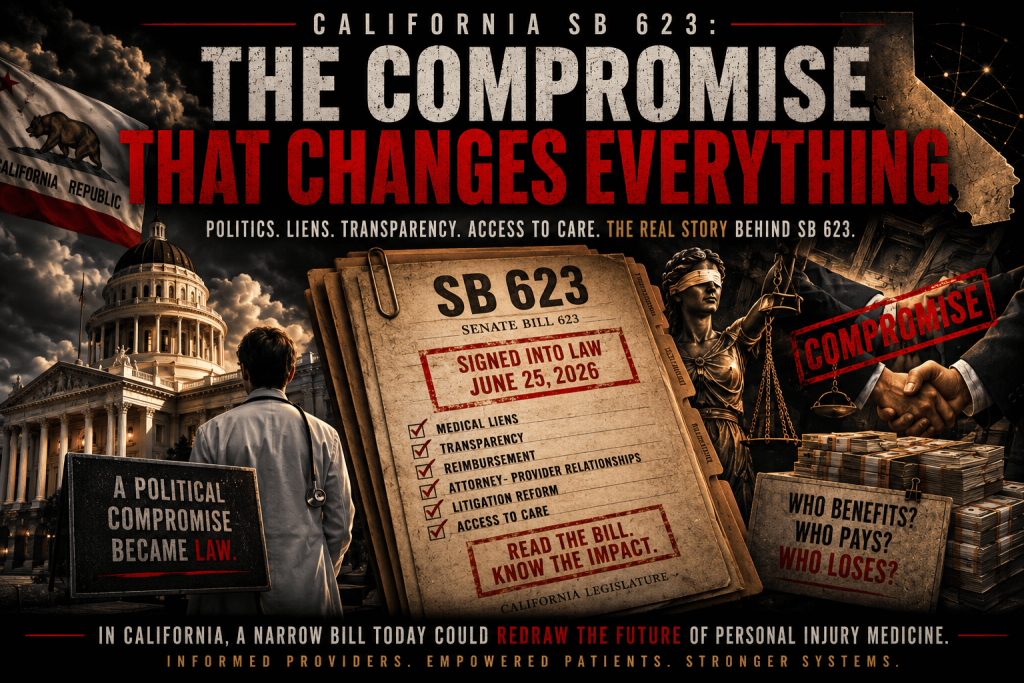
California’s newly enacted Senate Bill 623 (SB 623) is being hailed as a “historic compromise,” but for healthcare providers, the reality is far more complex. While marketed as a narrow fix for rideshare litigation, the legislation imposes substantial new financial and operational burdens on personal injury medical practices. In Part 1 of The Great Betrayal, we analyze the actual language of the bill, the lack of medical provider input during its rushed passage, and why this law sets a dangerous precedent for personal injury healthcare nationwide. It is time to look past the political talking points and understand how this legislation will impact your practice.