
THE GREAT BETRAYAL — What Healthcare Providers Aren’t Being Told About California’s SB 623
How California's Political Compromise Could Reshape Personal Injury Medicine By Michael Coates, Esq.
There are moments in public policy when the most important story isn’t found in the press release.
It isn’t found in the carefully crafted talking points.
It isn’t found in the headline celebrating a “historic compromise.”
The real story is often found in the statutory language and in the practical consequences that follow.
That is why every healthcare provider who treats personal injury patients should understand California’s newly enacted Senate Bill 623 (SB 623).
At first glance, SB 623 appears to be a narrow bill aimed at claims arising from rideshare accidents involving transportation network companies such as Uber. Many providers outside California may be tempted to dismiss it as someone else’s problem.
I believe that would be a mistake.
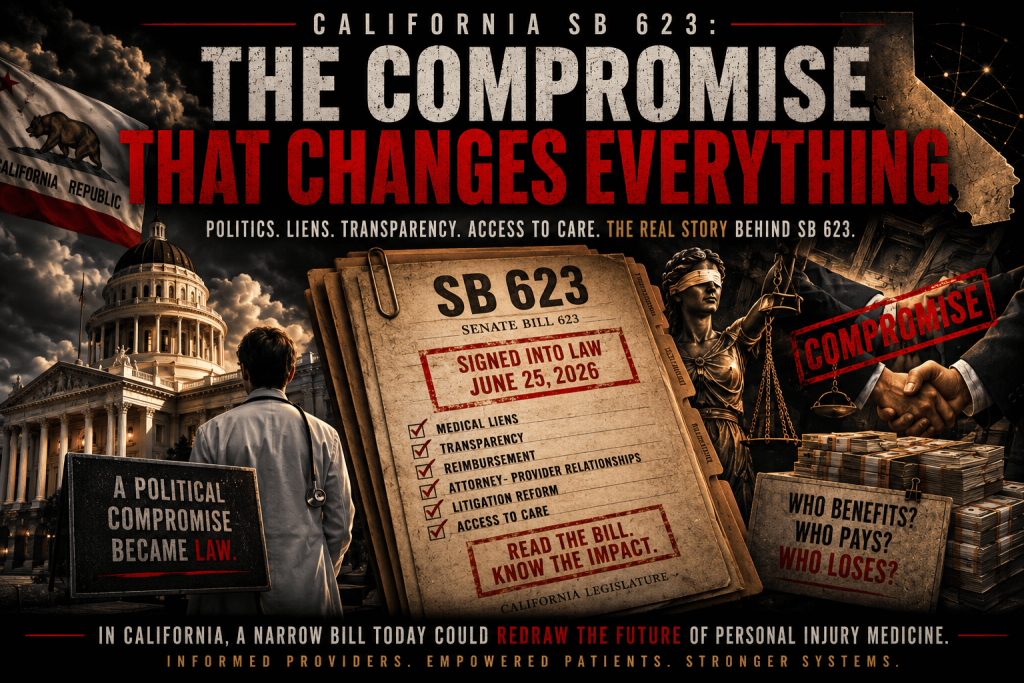
Whether one ultimately supports or opposes SB 623, the bill (now law) raises important questions about medical liens, access to care, provider reimbursement, attorney-provider relationships, litigation transparency, patient access to healthcare through surgical funding, and the future direction of personal injury reform. Those questions extend well beyond rideshare litigation.
In my view, SB 623 deserves careful study, not only because of what it does today, but because of what it may signal for tomorrow not just in California but around the country.
This series is intended to help providers, physicians, attorneys, and others understand the legislation, separate fact from speculation, and consider its potential implications for the personal injury healthcare system.
While you will get my opinion and I won’t be pulling any punches, I will also be giving you the facts and realities so you can analyze for yourself the impact.
A Political Compromise That Changed the Conversation
The background is important.
California was facing two competing ballot initiatives involving rideshare companies and personal injury law firms. One initiative proposed significant reforms affecting litigation involving transportation network companies, while the plaintiffs’ bar opposed those changes and advanced its own priorities as a counter to Uber’s push. Monies were raised by the legal lobby from not just law firms but medical providers and physicians to join the battle front.
Gavin Newsom, California’s Governor, had various ballot initiatives he was pushing as well, competing with voter attention.
Rather than allowing voters to decide between competing initiatives, negotiations resulted in a legislative compromise. The ballot measures were withdrawn, and SB 623 became the legislative vehicle for the agreement. And on June 25, 2026, that vehicle became law when signed by California’s Governor Newsom, a likely 2028 presidential candidate and whose current term ends this year.
That compromise resolved one political conflict.
But it also created an entirely new discussion for the healthcare community and consumer access to care groups.
When it comes to SB 623, many have focused primarily on attorney relationships, reimbursement issues, or day-to-day practice operations. Few have had the time, or perhaps the inclination, to read nearly every line of a bill that, on its face, appears limited to rideshare cases. And without reading that wording, or perhaps ignoring its effect and acting ignorant, the emails you’ve been receiving likely tout how great this compromise is for everyone.
Yet the details matter.
Because legislation often begins with a narrow application before influencing broader conversations about public policy and expanding the legal impact.
More Than Just an Uber Bill
Supporters of SB 623 generally describe the legislation as an effort to impose obligations on Uber and rideshare companies for rider safety, and then obligations on law firms and medical providers who treat rideshare personal injury patients to improve transparency, address perceived abuses involving medical liens, attorney referrals, and medical procedure funding, and reduce incentives that they believe contribute to excessive litigation costs.
Those who review the actual language will see something more. A lot more.
If you read the actual law, the legislation places substantial new operational and financial burdens on ethical healthcare professionals while harming a consumer’s fundamental access to the care they need yet can’t afford themselves.
Both perspectives deserve consideration of course. I just find you are getting only one side – those who want you to feel SB 623 is a victory for consumers and the medical providers and physicians who treat them.
Regardless of where one ultimately lands, the bill unquestionably changes the landscape for lien-based treatment in covered cases in California.
Among other things, SB 623 addresses:
- Recoverable medical expense damages at trial.
- The use of an unsupervised non-profit to benchmark and limit medical billing.
- Curtailing if not eliminating medical lien financing and surgical funding.
- Disclosure of attorney-provider referrals by someone other than the referrer.
- Discoverability of certain financial arrangements involving medical treatment.
- New documentation and declaration obligations for providers and physicians.
Those are not minor procedural adjustments.
They affect how providers evaluate financial risk, how attorneys prepare cases, how patients obtain treatment, and how the personal injury ecosystem functions.
Why Providers Should Pay Attention
For years, healthcare providers have operated in an environment that already carries significant uncertainty.
Treatment is often provided years before payment is received on what is mostly medically-financed healthcare, and the extra time, costs and overhead that go with it.
Providers frequently accept this financial risk in order to ensure that injured patients receive timely care and the hope of payment closer to their out-of-network rates.
Many practices have developed specialized administrative systems to manage liens, communicate with attorneys, maintain documentation, and navigate lengthy settlement and payment timelines.
SB 623 introduces additional considerations into that already complicated environment in California, and in my opinion, other states if not nationally as tort reform evolves and aggressive companies like Uber and insurers like Farmers, Geico and AllState push for ways to limit what they fear the most: nuclear verdicts.
A “nuclear verdict” is a normally viewed as a massive jury award that exceeds $10 million, typically vastly surpassing what would be considered a rational or expected amount. These payouts reach what some view as “thermonuclear” levels, reaching an even larger multiples.
Some California providers and physicians may conclude that the changes are manageable.
Others may determine that certain cases no longer make financial or operational sense and no longer treat car crash patients whether rideshare or otherwise.
Neither conclusion should be reached without understanding exactly what the legislation says.
The Questions That Matters Most
While you will be getting my direct opinion pulling no punches, the real purpose of this series is not to tell readers what to think, but to encourage them to think critically.
Whenever significant reform occurs, the most important questions are often the simplest:
Who benefits?
Who assumes additional responsibilities?
Who bears additional financial risk?
How might patient access to care be affected?
What problems does the legislation solve?
What new challenges might it create?
Did the money our profession contributed to the call to action get used against us and our patients?
Those questions deserve thoughtful discussion rather than slogans, especially when none of these questions were asked at the legislative or Governor’s office level when this bill was pushed through and signed in about a week’s time – unheard of for properly vetted legislation where those who might oppose portions have a chance to be heard.
A Word About “The Great Betrayal”
Some readers may wonder why I chose such a strong title for this series.
The phrase reflects a policy and personal opinion, not a legal conclusion.
After reviewing the legislative history, the statutory language, and the practical obligations created by SB 623, many providers and physicians may reasonably conclude that the final compromise shifted meaningful responsibilities and risks onto the medical community.
And, when you think about how the legal lobby came begging to medical providers and physicians to donate money (which they did) to battle the California Uber proposition only to have them shift burdens from lawyers to healthcare professionals without even seeking their input – I call that a great betrayal by the legal industry.
And, when you have a Governor and political system that can allow consumer and business rights to be negatively impacted without a right to be heard – I call that a great betrayal of our government and the legislative system.
Others may disagree.
Reasonable people can.
My goal is not to inflame that debate, but to start one that never had a chance to occur.
My goal is to encourage providers and physicians, and the medical organizations and associations advocating on their behalf, to participate in it from an informed position. And to bring that position before the California legislature and Governor’s office as soon as possible to perhaps submit an amended bill to remove or change certain provisions of the new law.
Too often, healthcare professionals become aware of legislative changes only after they begin affecting daily practice.
By then, the conversation has largely ended. But I refuse to remain silent on behalf of the medical profession I champion as a business, and at the same time, being part of the legal profession I am a licensed member of.
Why This Matters Beyond California
Although SB 623 currently applies to a specific category of transportation network company cases and only in California, history shows that legal reforms often influence broader policy discussions.
Successful ideas, whether viewed positively or negatively, are frequently examined, modified, and considered elsewhere.
That does not mean every state will adopt California’s approach.
Nor does it mean SB 623 will necessarily expand beyond its current scope.
I personally think it will be expanded to all personal injury cases in California, and that Uber has found a national roadmap to force a joint rideshare-legal lobby legislative push that shifts the burden to the medical industry, unfairly and improperly.
So this means, at least in my opinion, providers, physicians, and the organizations and associations that advocate on their behalf throughout the country should pay attention to the issues being debated and decide whether to act, and if so, to what extent.
The questions raised by SB 623 are not uniquely Californian.
They touch on national discussions involving healthcare costs, litigation transparency, access to care, medical billing, surgical funding, reimbursement, and the relationship between medicine and the legal system. It is the next level of tort reform that has been growing around the country, but here that tort reform has taken a unique twist than attempted before.
This Series Will Explore the Questions Others Aren’t Asking
Over the coming weeks, we’ll examine SB 623 from every angle:
- How this legislation became law in about a week.
- What the bill actually says.
- The significance of the phrase “void and unenforceable.”
- Why FAIR Health became a benchmark and what that means.
- New disclosure and declaration requirements on medical providers.
- The effect if not elimination on medical lien and surgical financing.
- The impact on patient access to care.
- Arguments supporting the legislation.
- Concerns that should be expressed by providers and physicians.
- Practical steps healthcare professionals should begin considering now.
I will then, post SB 623 recap, provide bonus articles individually to chiropractors, pain physicians, surgical MDs and ASCs, physical therapists, consumer patients, and even personal injury attorneys and Uber, rideshare companies and insurers themselves.
I will not delve in detail into many aspects of SB 623, such as the Uber-specific portions. My focus here is to wake up the medical profession to have an informed debate and determine what action, if any, should be taken.
Whether you ultimately believe SB 623 represents thoughtful reform, an overcorrection, or something in between, one thing is certain:
Healthcare providers and physicians cannot afford to ignore it.
Because understanding legislation before it affects your practice is always better than reacting after it does.
Next in the Series
The Bill Nobody Had Time to Review: How a Veterans’ Property Tax Bill Became One of California’s Most Significant Personal Injury Reform Measures.