When the Medical Malpractice Verdict Becomes the Weapon
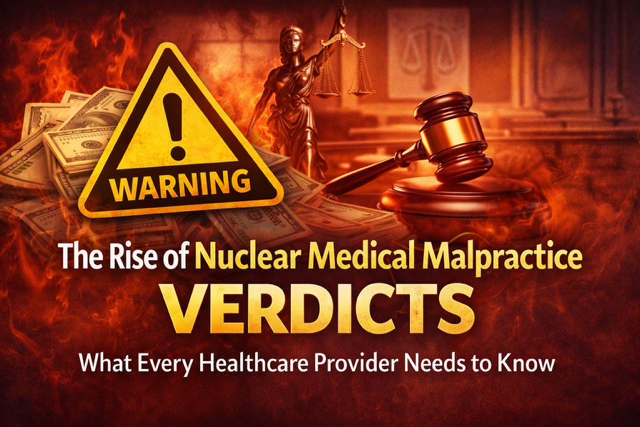
Why “Nuclear” Malpractice Awards Are Rising—and What It Means for Every Medical Provider
Over the past several years, something profound, and frankly alarming, has been happening inside courtrooms across the United States.
Medical malpractice verdicts are getting bigger.
Not incrementally bigger.
Not modestly bigger.
But exponentially bigger.
The same concern in many personal injury segments is giving rise to tort reform across the country is also in medical malpractice. The dreaded “nuclear verdicts.”
According to the American Medical Association (AMA), a nuclear verdict is defined as a jury award exceeding $10 million. And these verdicts are no longer rare outliers. They are becoming disturbingly common.
In fact, citing data from The Doctors Company, a leading medical liability insurer, the AMA reports that the average of the top 50 medical malpractice verdicts has skyrocketed:
- $32 million in 2022
- $48 million in 2023
- $56 million in 2024
That is not normal inflation.
That is not coincidence.
That is a systemic shift.
And if you are a physician or healthcare provider, this trend should matter deeply to you regardless of specialty, practice size, or perceived risk.
What’s Driving These Nuclear Verdicts?
According to the American Medical Association and senior AMA attorney Wes Cleveland, there are several converging forces behind this explosion in verdict size. Together, they form a perfect storm.
The first driver is loss of public trust in healthcare.
Over the last decade, and accelerated by the COVID-19 public health emergency, many patients no longer see healthcare as personal. They see it as corporate, distant, and transactional.
As healthcare has become more corporatized, patients often feel disconnected from a doctor and instead feel processed by a system. When something goes wrong, juries are less inclined to give that system the benefit of the doubt.
Trust erosion fuels punishment.
Social Inflation: When Perception Changes Reality
The AMA refers to another powerful force as “social inflation.”
Social inflation occurs when claim amounts rise faster than traditional economic inflation, not because damages are objectively larger, but because jurors’ perceptions have changed.
Jurors today are:
- More comfortable with massive numbers
- Less shocked by eight-figure awards
- More inclined to “compensate” plaintiffs even when negligence is unclear
When people regularly hear about athletes signing $100 million contracts or actors earning $20 million per film or the TV personal injury ads of mega-millions recovered for car accidents as if routine, a $10 million or $30 million verdict no longer feels extraordinary.
It feels…reasonable to many jurors. That shift alone fundamentally alters the risk landscape for providers.
The Reptile Theory: Fear as a Legal Strategy
One of the most concerning tactics highlighted by the AMA is known as the “reptile theory.”
First introduced in 2009, this strategy shifts the focus of a malpractice case away from what actually happened to a specific patient and instead reframes the case as a threat to the entire community.
The goal is not to prove negligence alone. The goal is to activate fear.
Attorneys using reptile tactics establish broad, commonsense-sounding safety rules:
- “Patient safety is the highest priority, correct?”
- “It’s never acceptable to violate a safety rule, right?”
- “When safety rules are violated, the public is put at risk, correct?”
Once those statements are agreed to, the jury is no longer deciding one case.
They’re defending their community.
As Cleveland explains, reptile theory focuses on what could have happened, not strictly what did happen. And fear is a powerful motivator when deciding damages.
Anchoring: The Power of the First Number
Another contributor to nuclear verdicts is a deceptively simple psychological tactic known as anchoring.
Plaintiffs’ attorneys often ask for damage amounts far higher than what they realistically expect to receive. For example, asking for $30 million instead of $20 million, or $50 million instead of $30 million. This happens all the time in personal injury medical lien negotiations which is my primary lane of expertise.
Why?
Because once a number is introduced, the jury (and anyone you might negotiate with a say in a business dealing) subconsciously uses it as a reference point.
Multiple studies, including research cited by Harvard Law School and Boston University School of Law, show that high anchors reliably produce higher verdicts, even when jurors consciously attempt to be fair.
Some states, like Georgia and Utah, have begun passing tort reform laws to limit this tactic. But in many jurisdictions, anchoring remains a powerful and largely unchecked influence.
Bullying and Psychological Pressure
Finally, there is a tactic rarely discussed publicly but deeply impactful personally: bullying.
Some plaintiffs’ attorneys threaten physicians directly, implying that if a case does not settle, the physician’s personal assets, such as their home, savings, children’s education funds, could be targeted.
While such outcomes are often unlikely in practice, the threat itself can be devastating.
As the AMA notes, these tactics can be psychologically damaging, increasing stress, anxiety, and burnout especially for physicians already under immense pressure.
And again, I see this all the time with physicians and medical offices merely negotiating payment of their medical bills in personal injury cases. So, image the stress impact when 10x to 100x is involved.
Why This Matters to Every Provider
This trend is not just about money. It affects:
- Medical liability insurance premiums
- Defensive medicine
- Provider burnout
- Access to care in high-risk specialties
- Long-term sustainability of medical practice
The AMA has been clear: the system is strained, and without reform, conditions could worsen.
That’s why the AMA is actively advocating for medical liability reform, including:
- Safeguards for physicians’ personal assets
- Limits on irrelevant or coercive trial arguments
- Fair treatment of economic damages
- Expanded protections for providers acting in good faith
The extent to which that kind of reform is successful will be up to the industry rallying, contributing not just their voice but their money for the cause.
The Bigger Picture
Nuclear verdicts are not just legal events. They are cultural signals.
They reflect changing public trust, shifting jury psychology, and evolving legal strategies. And they serve as a reminder that medicine today exists not just in exam rooms, but in courtrooms, negotiations, headlines, and public opinion.
Understanding these forces doesn’t make you defensive. It makes you informed.
And in this environment, informed providers are better positioned to protect themselves, their patients, and the future of care itself
And that starts and ends with doing medicine right. Stay vigilant with ethical stands, and don’t cross ethical boundaries. Stay in your lane. Continue improving not only your medical skills but also your business skills and overall awareness. As not just independent medical practices, but the industry itself, is under attack for all sides.