Avoid Audits of Your Practice at All Costs
Why Modern Medicine Must Design to Withstand Scrutiny—Not React to It
What I tell my CPA every single year is simple: “Make sure I never get audited—and if I do get audited, I want to beat it.”
No red flags. No unnecessary attention.
Unfortunately, what most understand too late is that even when you win an IRS audit, you still lose. You lose time. You lose focus. You lose peace of mind. You pay professional fees you never planned for. And if you don’t win? That loss becomes painful, and fast.
Medicine is no different, except the consequences can be far worse.
In healthcare, audits don’t just result in letters and explanations. They can trigger massive payback demands, restitution to patients, civil penalties, license exposure, and in extreme cases, criminal scrutiny. And the audit environment today is more aggressive than it has ever been.
Right now, insurance companies are tightening documentation requirements across the board. CMS and private insurers are aggressively requesting medical records. Providers are being hit with large recoupment demands when documentation fails to meet heightened and often evolving standards.
And the trend is clear: more delays, more denials, and more audits.
Why? Because payer automation and AI-driven post-payment review systems are now being used as flagging tools. Algorithms are scanning for patterns that “don’t look right,” and once flagged, your practice moves from invisible to targeted. On top of that, just add third party vendors that payers and others are retaining to outsource medical necessity and compliance reviews.
That microscope becomes even more intense in personal injury (PI).
In PI segments, scrutiny expands beyond documentation into billing behavior, especially comparisons between cash rates and out-of-network billed rates. Large gaps between those numbers are increasingly being interpreted as potential evidence of inflated or false charges.
Suddenly, what once felt like a reasonable business decision puts you in dangerous territory.
And here’s where most practices get blindsided: things can look legal and still cross gray lines faster than you think.
That’s why, just like you rely on an ethical CPA to protect you from tax exposure, you need better processes and ethical rechecks to protect your medical practice.
Because audits don’t just come from insurer SIU divisions.
They come from Medicare.
They come from medical boards.
They surface during depositions and discovery in litigation.
And once questions arise, referrals are made to agencies you never want putting a magnifying glass to your business.
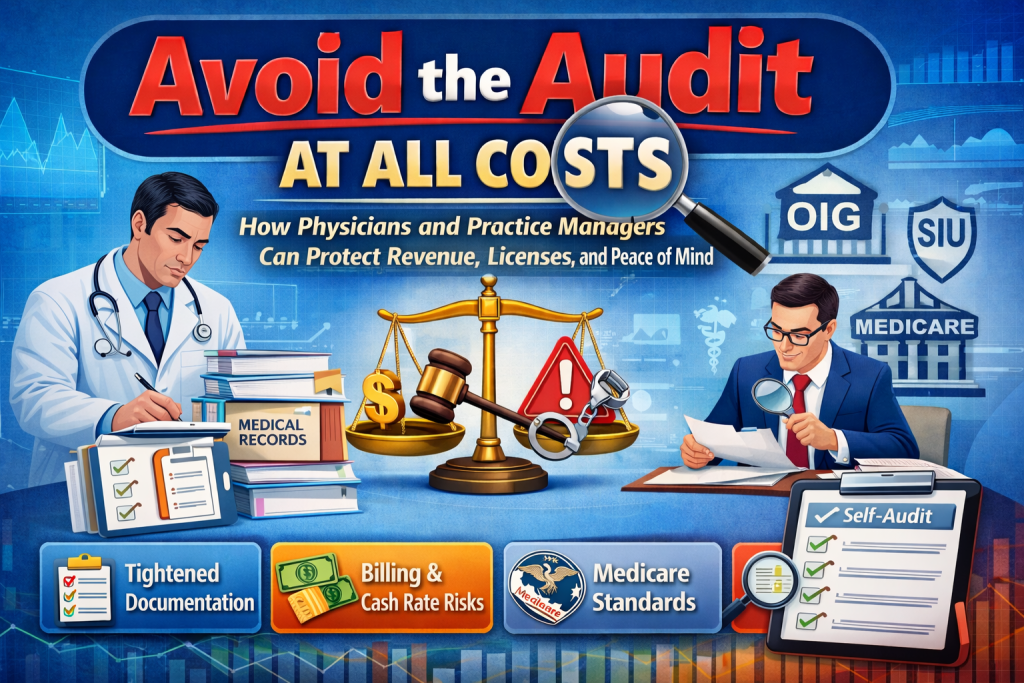
This is exactly why the Office of Inspector General recommends at least one self-audit per year as part of an effective compliance program. And I wholeheartedly agree. Waiting to be audited is not a strategy. It’s a gamble.
The good news is that you don’t have to guess where to start.
Medicare provides free tools, checklists, and guidance through the Medicare Learning Network. And here’s a key principle every physician and office manager should understand:
If your diagnosis, treatment, documentation, coding, and billing align with Medicare standards, you are typically well positioned with all other payers and reviewers.
Medicare compliance isn’t just about Medicare patients. It’s about building a defensible practice.
But there’s an important caution when it comes to self-audits: bias.
It is extremely difficult to remain objective when reviewing your own work. We naturally justify our notes, our decisions, and our fees because we remember the intent behind them. That’s why collaborating with a trusted colleague, while strictly following HIPAA protocols, can be incredibly valuable.
Exchanging records for peer review introduces objectivity. And that review should include not just documentation, but also fees and cash rates.
In fact, one of the smartest approaches today is to use AI yourself as a self-audit tool, essentially an AI versus AI method. If payers are using automation to flag risk, providers should be using intelligent tools to identify vulnerabilities before someone else does.
One of the most effective “common sense” clinical audit methods I’ve seen comes from Dr. Evan Gwilliam: the Reverse SOAP Note Audit.
Instead of starting with the subjective complaint and moving forward, this method starts with what you actually coded and billed in the Plan section and works backward through the Assessment, Objective, and Subjective sections. The goal is simple but powerful: ensure that the clinical story fully supports medical necessity and proper billing for every service billed.
If the story doesn’t justify the code, you’ve found a risk point before an auditor does.
But documentation alone is not enough.
You also need to evaluate whether your fees are defensible. That means performing UCR comparisons using accepted methodologies and objective data sources. Tools like Fair Health Consumer allow you to compare your out-of-network charges to regional and national averages. If your fees fall significantly outside those ranges, that doesn’t automatically mean they’re wrong, but it does mean they require stronger justification.
Whether you self-audit, collaborate with peers, use AI tools, or bring in compliance professionals, the takeaway is clear:
Proper documentation and billing support are insulation.
They protect you from audits.
They reduce avoidable denials and delays.
They limit financial and regulatory exposure.
And they make your practice stronger, cleaner, and more resilient.
The real goal isn’t to fight attacks after the fact. That’s the more expensive and riskier path.
The goal is to design clinical and operational processes identified through self-audit that anticipate payer and third-party scrutiny before it ever becomes a problem.
Do PI right. Do your entire practice right. Stay ahead of the curve.
Avoid the audit, not through fear, but through discipline.
Because this isn’t just compliance. It’s good medicine. And it’s good business.