
Don’t Let Time be a Profit Thief
How Unprotected Delays Quietly Steal Your PI Profits and How to Stop Them
In personal injury, there is a thief operating in plain sight.
It doesn’t break windows.
It doesn’t trip alarms.
And it doesn’t show up on a police report.
Its name is Time.
And if you don’t actively protect against it, time will quietly, and consistently steal your profits.
Think about how seriously we take protecting our homes. We install security systems. We put up cameras. We lock doors. We rely on watchful neighbors. We do all of that because we understand a simple truth: if something valuable is left unprotected, someone or something will eventually take advantage of it.
Yet in PI, one of the most valuable assets you have—time tied to money—is often left completely exposed.
Not because you don’t care.
Not because you don’t work hard.
But because time theft in PI doesn’t feel dramatic. It feels slow. Polite. Administrative. Procedural.
And that’s exactly why it’s so dangerous.
Time shrinks profits in PI in ways that compound quietly:
- Delayed notifications
- Missed follow-ups
- Unanswered calls
- Untracked case milestones
- “We’ll get back to you” moments that never quite arrive
Each delay chips away at leverage, clarity, compliance, and ultimately … cash flow.
But here’s the good news:
Time is a thief—but it is not unstoppable.
Just like protecting your home, you can install security measures that limit the damage time can do.
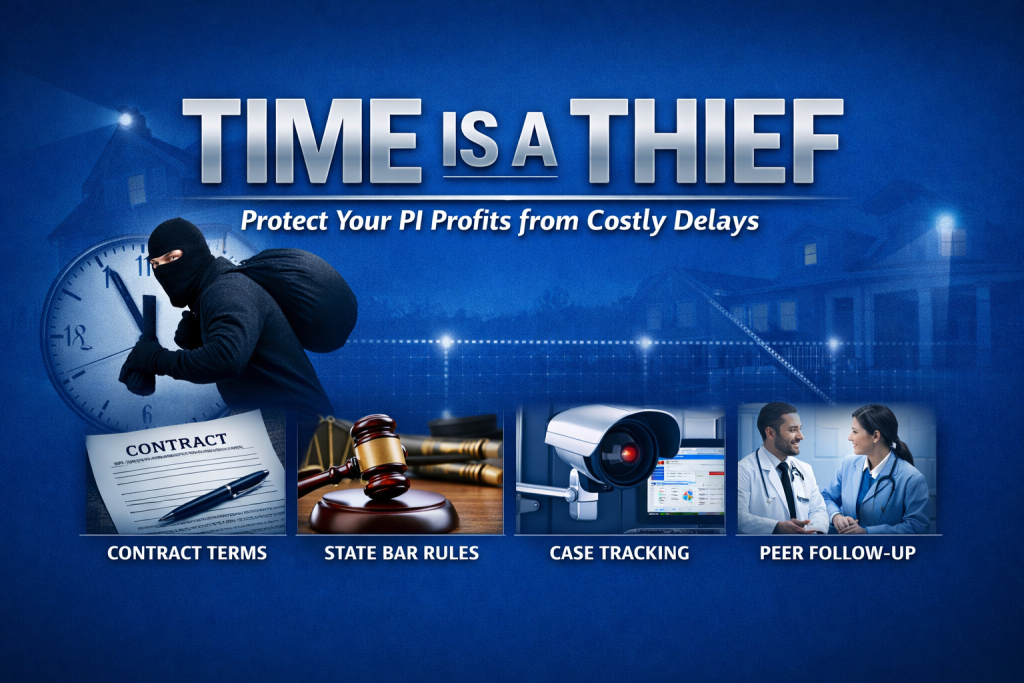
Let’s talk about four of them.
Security Measure #1: Contracts — Your Alarm System
The first line of defense against time theft is protection by contract.
Contracts are your security system. They don’t just define fees. They define expectations, obligations, and timelines as a matter of law—contractual law.
In personal injury your primary contract is your medical lien agreement. Whether signed by both your patient and the current attorney in a “lien” state, or by the patient only in a “LOP-only” state.
Well-drafted PI lien agreements can mandate:
- When you must be notified of settlement events
- How quickly information must be provided or an interpleader filed
- When bill reduction requests must be addressed
- What constitutes non-compliance including delays
- When interest accrues on the outstanding billed amount
Without time provisions, delays feel “reasonable.” With time provisions, delays become measurable and enforceable.
And that matters. Because ambiguity is time’s best accomplice.
In the end, interest is your only real protection against how long PI claims and lawsuits take to resolve. You don’t have to enforce an interest provision, yet it will provide leverage that you can give up or use as a negotiation method to get your full bill paid or much closer to your full bill.
When timelines are contractual, you’re no longer chasing updates. You’re enforcing agreements.
That’s not aggressive.
That’s professional.
That’s secure.
Security Measure #2: State Bar Rules — Licensing Enforcement
The second layer of protection is state bar rules.
These are not suggestions. These are regulatory requirements, and many of them include specific timing mandates that exist to protect all parties involved, including medical providers.
For example, in California, attorneys are required to notify lienholders within 14 days of receipt of settlement funds.
That’s not courtesy.
That’s compliance.
Understanding and leveraging state bar timing rules is like having law enforcement backing your security system. You don’t have to threaten. You don’t have to posture. You simply have to know the rules and calmly reference them when necessary.
Time delays lose their power when delays carry consequences.
Security Measure #3: Tracking — Your Cameras
The third protection against time theft is tracking.
Tracking is your camera and video system. One you control.
Too many practices rely on attorney updates alone. And while attorneys play a central role, they are not the only source of truth.
Tracking means:
- Monitoring case status proactively
- Following up at defined intervals
- Checking not only with the law firm, but also with your patient
- Documenting communications and milestones
- Reviewing when law firms are consistently late in payments
If you don’t track, you don’t see delays until they’ve already cost you leverage.
Cameras don’t stop everything. But they can stop surprises. And in PI, surprises can be expensive.
Security Measure #4: Peer Follow-Up — Your Neighbors
Finally, there’s peer follow-up.
If you referred a patient to another provider, or they referred a patient to you, that peer may have information you don’t.
They may have received:
- Settlement notifications
- Requests for records
- Attorney communications
- Case updates
When the law firm and patient go quiet, peers become your watchful neighbors.
A simple professional check-in can surface information that would otherwise remain hidden for weeks or maybe months.
Isolation is where time does the most damage. And peer connections can limit it.
You Can’t Stop Time—But You Can Stop the Theft
Let’s be clear:
There are things time will always take from us.
We can’t stop our kids from growing up.
We can’t rewind missed moments.
We can’t pause life.
But in PI, we can stop, or at least dramatically limit time from stealing our profits.
We do it by:
- Installing contractual protections
- Knowing and using regulatory timelines
- Tracking cases and payments instead of hoping
- Leveraging peer connections for insight instead of waiting
Time only steals when it’s left alone with something valuable.
Protect what you’ve earned.
Secure what you’ve built.
And stop letting time walk out the back door with your profits.
Because in PI, time isn’t just money.
Time is a thief—and now you know how to lock the doors.
I know you are each a great medical provider. It’s time to also be great business owners and great office managers and protect your profits.