Sharing is Caring 📤

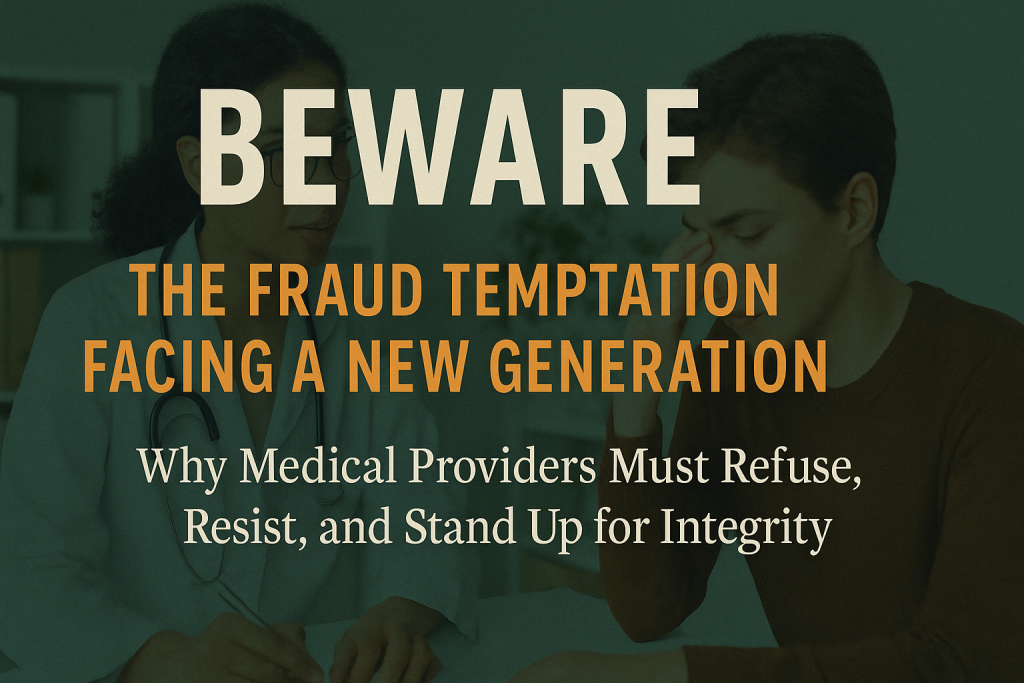
Patient Fraud: Why Medical Providers Must Refuse, Resist & Stand Up for Integrity

Today I want to sound an alarm about something that is both troubling and urgent. A recent insurer study revealed something that should disturb every one of us: two out of five young adults between the ages of 25 and 34 believe it’s okay to defraud insurers. They see it not as theft, but as a clever way to save—or even make—money.

This isn’t just a statistic. This is a mindset shift, a generational disconnect between the values I grew up with as a baby boomer and what some in younger generations are coming to accept. It’s a dangerous trend for our society, our patients, and most importantly, our medical profession.  As someone who coaches and guides medical providers in personal injury, and as a father of six and grandfather of three, I take this personally.

The Medical Office Risk

Now, let’s be blunt. This isn’t just about some nameless person fudging their auto claim or lying on a policy application. For you, the medical professional, this problem is coming right through the front doors of your offices. And even worse, some providers are not just ignoring the fraud; they are participating in it.

If you are padding claims, inflating bills, or working with patients to “game the system,” let me say this as directly as I can: STOP. You are committing fraud. You are risking your license, your reputation, and your livelihood. No check is worth your integrity.

The Subtle Traps of Fraud

You might say, “Well, I would never commit fraud.” Good. I hope that’s true. But let me tell you where the traps are, because patients may try to pull you into them without you even realizing it. According to the Coalition Against Insurance Fraud, here are some of the most common forms of fraud that many young people mistakenly think are harmless or clever: padding claims, lying on forms, false medical billing, omitting key details, exaggerating injuries and losses.

These are not gray areas. These are black-and-white cases of fraud. They are illegal. They are unethical. And if you participate, knowingly or unknowingly, you are complicit.

Why This Trend Is Growing

Why is this happening? Why do so many young people feel it’s okay to cheat insurers? Part of it is cultural. Some younger generations see large corporations, especially insurers, as faceless, wealthy giants who “deserve” to be taken advantage of. They rationalize it by saying, “It’s not really hurting anyone.”

You know better. Fraud doesn’t just hurt an insurance company’s balance sheet. Fraud drives up premiums for every honest policyholder. Fraud strains trust between insurers and providers, making it harder for legitimate claims to be paid fairly. Fraud poisons the very ecosystem you work in every day.

Your Responsibility as Providers

That’s why you, as medical providers, have to be vigilant. You cannot let your guard down when patients come in with questionable stories, incomplete records, or pressure to “help them out.” You have to keep our antennae up.

Here’s the reality: you may be the last line of defense. You may be the only person in the chain of care who can say, “Wait a minute, this doesn’t look right.” If you look the other way, if you “go along to get along,” then you are helping to fuel the problem.

Remember: your license is not renewable once it’s revoked. Your reputation is not repairable once it’s destroyed. And your integrity is not replaceable once it’s compromised.

A Generational Call to Action

Now, I want to step back for a moment. Yes, this is about fraud. Yes, this is about legal and financial risk. But it’s also about something bigger: it’s about character.

We as elders owe it to the younger generations to call this out. We cannot shrug our shoulders and say, “That’s just how kids think these days.” No. Integrity matters. Character counts. And sometimes that means “sticking our nose in” and mentoring younger providers, younger staff, even younger patients.

Because if we don’t, who will? If we don’t model and stand up for integrity, then the fraud trend only grows stronger, and the damage only spreads wider.

Practical Steps for Standing Up

So what can you do? Let me give you three simple but powerful steps:

  1. Educate Your Team: Make sure everyone in your office knows what qualifies as fraud. Sometimes staff members don’t realize that small shortcuts or patient “favors” cross legal lines. Knowledge is the first defense.
  2. Establish Clear Policies: Have written procedures in your office about billing, documentation, and patient interactions. When a questionable situation arises, your staff should know exactly what to do, and perhaps more importantly, what not to do.
  3. Be Willing to Say No: This is the hardest part. You may have to turn away a patient. You may have to decline a referral. You may have to walk away from easy money. But remember: every “No” you say to fraud is really a “Yes” to protecting your license, your reputation, and your integrity.

Conclusion: The Stand We Must Take

Friends, this is not a small issue. This is not a victimless crime. Fraud, whether by patients, providers, or insurers themselves, is a cancer for the medical profession and our society. And today we are seeing a troubling rise in younger generations accepting it as “clever” or “normal.”

But we don’t have to accept it. We don’t have to participate. And we don’t have to stay silent.

Let us take a stand together. Let us mentor and guide those younger than us. Protect your offices, your licenses, and your reputations. And let us all remember that at the end of the day, what matters most is not the money we collect, but the integrity we keep.

Because insurance claims come and go, patients come and go, and money comes and goes. But character? The character stays. And it is priceless.

Are You Treating Personal Injury Patients—or Looking to Start?

Discover proven strategies to streamline your processes, boost your profits, and grow your practice. Join our email list to stay ahead with expert insights, legal coordination tips, and real-world tactics that work.

P.S. We offer choices for all offices to improve processes, grow your PI segments, and to get paid far more. The choice is yours:

DONE-FOR-YOU: Consider outsourcing to PI Billing Pros (no real financial risk; a pro does it for you saving you time and stress)

DONE-WITH-A-PRO: Join the Business Advantage Coaching Membership (affordable; for better, faster & easier than pure DIY; staff trained too)

DO-IT-YOURSELF: Get the Book that is the main guide for PI for medical providers, and enroll in Negotiations Training  (inexpensive; requires the most time by self-implementing)

Featured Articles

This website is meant for general information and not legal advice.

Become a Master of Personal Injury Negotiations. Learn the critical skills and techniques, and gain the confidence you need, to negotiate your way to far higher payments and measurably higher net profits. Designed specifically for medical providers and staff that handle personal injury cases.

$299

The Roadmap to Personal Injury Success!

This book, authored by Michael Coates, Esq, titled Personal Injury Made Easy,  A Medical Provider’s Roadmap to Successfully Navigate the High-Profit Highway, is the most thorough work on the subject.

Join our Business Advantage Program

Running a medical practice is something they don’t teach you in school, especially when it comes to personal injury.  We provide coaching, training, mentoring, and on-demand education to help make your PI practice more profitable.

Let a PRO negotiate with YOUR law firm!

Having problems dealing with PI law firms? Personal Injury Billing Pros negotiates for you, recovering what your medical practice has earned & deserve.

PI Made Easy Insiders on Facebook

If you are a medical professional and involved in personal injury, join our PI Insiders Facebook group. A private group to ask questions and join discussions with other medical PI professionals and a few of our guest experts.

Recent Articles

Title graphic reading "The Great Betrayal Part 2: How Did SB 623 Become Law in Just One Week?" with a dark background featuring the California State Capitol dome.

THE GREAT BETRAYAL — Part 2: How Did SB 623 Become Law in Just One Week?

How did a bill meant to protect veterans’ property tax exemptions suddenly morph into one of California’s most consequential personal injury reform laws in just seven days? Michael Coates, Esq. pulls back the curtain on SB 623 and the controversial “gut-and-amend” process that left healthcare providers and personal injury lawyers completely out of the legislative conversation until the ink was already dry.

Read More »
Dramatic graphic for California SB 623 showing a hand holding a redacted legislative document under a stormy sky, with the California Capitol building and a group of corporate or political figures standing over stacks of money.

THE GREAT BETRAYAL — What Healthcare Providers Aren’t Being Told About California’s SB 623

California’s newly enacted Senate Bill 623 (SB 623) is being hailed as a “historic compromise,” but for healthcare providers, the reality is far more complex. While marketed as a narrow fix for rideshare litigation, the legislation imposes substantial new financial and operational burdens on personal injury medical practices. In Part 1 of The Great Betrayal, we analyze the actual language of the bill, the lack of medical provider input during its rushed passage, and why this law sets a dangerous precedent for personal injury healthcare nationwide. It is time to look past the political talking points and understand how this legislation will impact your practice.

Read More »
An illustrated infographic titled Avoid the Audit at All Costs showing a doctor reviewing medical records and an auditor with a magnifying glass examining compliance documents.

Avoid Audits of Your Practice at All Costs

Winning an insurance or tax audit still means losing time, money, and peace of mind. In modern medicine, the consequences are even higher. Discover why waiting for an audit is a gamble and how to use proactive self-audits, peer reviews, and AI tools to insulate your practice against automated payer scrutiny.

Read More »
Medical professionals standing together under a large red and blue umbrella labeled Personal Injury protecting them from a healthcare storm filled with dark umbrellas symbolizing declining reimbursements, healthcare crisis, and SIU investigations.

Protect Your Medical Practice from the Evolving Healthcare Storm

Independent medical practices are facing a perfect storm of declining insurance reimbursements, rising costs, and aggressive audits. Discover why structured, compliant Personal Injury (PI) is no longer just an optional side-revenue stream, but the ultimate umbrella for protecting your autonomy and thriving in today’s healthcare climate.

Read More »
A split-screen illustration showing medical professionals in lab coats on the left and attorneys in business suits on the right pointing at each other over a torn document labeled negotiation, representing conflict in the personal injury industry.

Personal Injury (PI) is an Industry of Professional Pushback

In the personal injury industry, conflict isn’t a flaw—it’s a feature. While medical offices are wired to heal, law firms are trained to argue. Discover why avoiding disagreement is costing your practice, and how mastering the art of “professional pushback” is the ultimate key to maximizing your ROI, earning attorney respect, and securing long-term referrals.

Read More »

— An Investigative Series · California SB 623

A New California Law Could Change Personal Injury Healthcare

Discover how SB 623 could impact healthcare providers through our 10-part investigative series, The Great Betrayal.

Reserve Your Spot

Secure your seat today. Choose the discussion topic that interests you and join our Open Mic Zoom conversation on the issues impacting healthcare providers. Attendance is limited.

We’ll only use this to confirm your reservation and send event updates.

Your Seat Is Reserved!

Thank you. Please mark your calendar. We will be sending out invitations shortly with the meeting information.