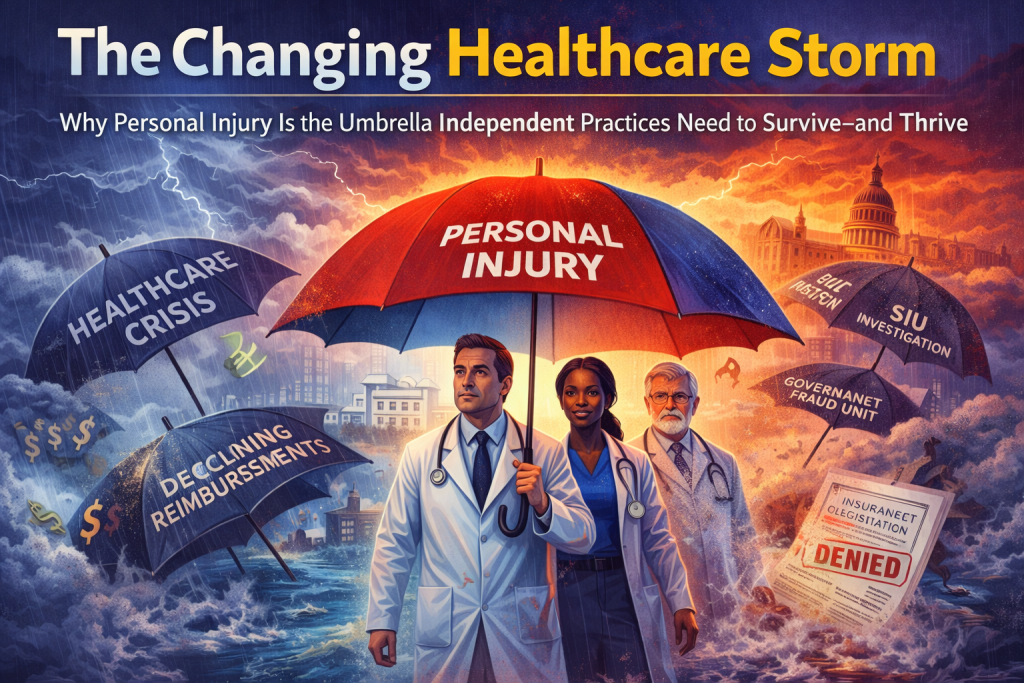
Protect Your Medical Practice from the Evolving Healthcare Storm
Why Personal Injury is the Umbrella to Survive and Thrive
Let’s start by calling out the rain coming down hard on medical practices in every state.
Independent medical practices are standing in a healthcare storm made up of very real, very measurable forces.
Reimbursements from traditional health insurance continue to decline, year after year, while expectations, documentation requirements, and audit risks continue to rise. At the same time, operating costs are climbing fast: rent, staffing, benefits, technology, compliance, and malpractice coverage all cost more, not less.
Layer on top of that expanding government legislation and regulatory scrutiny that increasingly targets independent medical practices, not just hospitals. Add in aggressive insurer behavior, especially Special Investigation Units(SUIs) scrutinizing treatment patterns, documentation, billing frequency, and medical necessity with the assumption that providers are guilty until proven otherwise.
That’s the rain.
And it’s not hypothetical. It’s already soaking practices across the country.
So, when we talk about survival and success for independent medicine, we can’t talk in generalities. We have to talk strategy. Because this storm is not passing quickly and pretending it isn’t there is no longer an option.
The real question becomes: what umbrella are you holding?
For providers, their organizations, and the vendors who truly care about them remaining independent, the answer is clear:
PI, done correctly, is the largest and safest umbrella.
Not the messy, unmanaged, “figure-it-out-as-you-go” version of PI that creates fear and frustration. But structured, compliant, well-supported personal injury built on education, systems, value-driving and professional alignment.
Let’s address the elephant in the room. Many practices hesitate around PI because they’ve seen it done badly, for example:
They’ve seen unpaid PI bills.
They’ve seen aggressive bill reductions.
They’ve seen staff confusion and burnout.
They’ve seen attorneys dictate terms and direct medical treatment.
They’ve seen cash flow stretched and hope substituted for process.
That doesn’t mean PI is broken. It means execution was broken.
In a storm, the umbrella doesn’t fail because it rains.
It fails because it’s cheap, poorly designed, or used incorrectly.
When PI is done right, it becomes one of the few remaining areas in healthcare where care is still valued rather than commoditized.
PI allows physicians to step outside shrinking fee schedules and race-to-the-bottom reimbursement models. It rewards time, evaluation, documentation, causation analysis, and outcomes—not just speed and volume.
Yes, PI has longer account receivable cycles, but they are predictable.
Yes, PI requires stronger storytelling documentation, but it’s doable and defensible.
Yes, PI requires relationships, but those relationships are expansive with patients and peers and good law firms, not dependency on difficult attorneys who cross ethical boundaries and want to take advantage of you.
Compare that to traditional healthcare today: denials without logic, claw backs months later, silent policy changes, and audits driven by algorithms or AI review instead of clinical judgment.
One environment is chaotic and reactive. The other is complex, but manageable.
That difference matters.
PI also provides something independent practices desperately need right now: revenue diversification.
Practices that rely exclusively on insurance-based care are exposed from every direction. When one payer tightens rules, margins collapse. When staffing costs rise, there’s no buffer. When audits hit, there’s nowhere to hide.
PI acts as a stabilizer.
It smooths payer mix volatility.
It strengthens cash flow planning.
It creates referral networks outside of insurance panels.
It forces operational maturity, from better intake, better documentation, better tracking, to better staff training.
And here’s a message that vendors, consultants, and advisors need to hear clearly:
If you truly care about your provider clients surviving as independent practices, PI must be part of the conversation.
Not as a side option.
Not as “some offices do that.”
But as a core pillar of long-term sustainability.
Independence doesn’t fail because doctors aren’t good clinicians. It fails because practices lack business leverage.
PI creates leverage when guided properly and done right.
It teaches offices how to use a biopsychosocial approach to trauma-based care for improved patient outcomes.
How to negotiate instead of accept what’s dictated.
How to protect lien rights and reduce avoidable losses.
How to build ethical, reciprocal relationships with patients, peers and good attorneys.
How to train staff to manage cases confidently instead of reactively.
How to stop discounting your value out of fear and start operating with data and process.
Many practices hesitate because PI feels unfamiliar. Unfamiliar feels risky.
But let’s be honest: what’s riskier right now: learning a structured, supported PI model, or remaining fully exposed to an insurance-driven system that is actively eroding your margins?
Storms don’t reward hesitation. They reward preparation and action done right.
The practices that survive this healthcare storm won’t necessarily be the biggest or the loudest. They’ll be the ones who recognized the rain early and chose the right umbrella.
PI is not a silver bullet. But in this environment, it is one of the strongest tools independent medicines remaining.
The key isn’t whether you do PI. The key is how you do PI.
With education instead of assumptions.
With systems instead of hope.
With guidance instead of trial-and-error.
With professionalism that earns respect from attorneys, insurers, courts, peers and patients alike.
Independent medicine doesn’t have to disappear. But it does have to evolve.
The storm is already here. Grab the right umbrella.
And that umbrella is personal injury – made easy – and done right.