
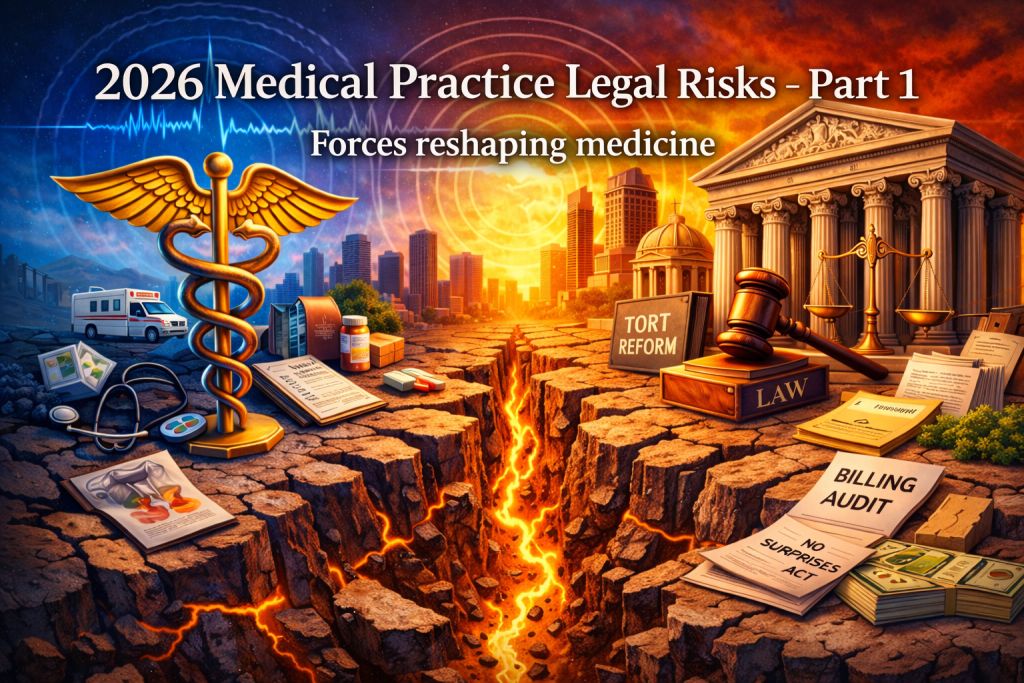
The Legal Ground Is Shifting Beneath Your Practice – Part 1
The Compliance, Liability, and Corporate Forces Reshaping Personal Injury Medicine in 2026
As we move into 2026, medical practices, including those with a personal injury (PI) segment, are no longer operating in a legal environment that is merely “tightening.”
It is restructuring.
This shift is not driven by a single regulation, audit, or bad actor. Instead, it is the result of converging pressure from regulators, insurers, legislators, and large corporations—each advancing changes that, together, fundamentally alter risk for medical offices nationwide.
Personal injury care sits at the intersection of medicine, law, insurance, and large corporate transportation liability. When that intersection is redesigned, the PI sector feels it first and most intensely.
Let’s begin with the foundational fault lines shaping that reality.
1. HIPAA Is Now a Living Risk System, not a Vendor Checkbox
HIPAA compliance once felt manageable. Policies were drafted. Annual training was completed. An IT vendor was retained.
That model no longer holds.
In 2026, HIPAA is being enforced as a living security and accountability framework. Regulators now expect medical practices to demonstrate understanding, oversight, and ongoing risk management, not static documents or vendor assurances.
Enforcement emphasis continues to grow around:
- Multi-factor authentication and access controls
- Encryption of electronic protected health information (ePHI), both stored and transmitted
- Updated Notices of Privacy Practices reflecting expanded patient rights
- Clear accountability when breaches involve third-party vendors
This is where Business Associate Agreements (BAAs) move from boilerplate to mission-critical.
Billing companies, IT vendors, cloud platforms, record services, imaging portals—these are all business associates. If a breach occurs and your BAA is outdated, vague, or generic, your practice may still bear liability even when the vendor caused the breach.
PI practices are especially exposed due to the constant movement of records between providers, attorneys, insurers, vendors and middlemen entities. Each transfer is a risk.
In 2026, most HIPAA problems will not originate from sophisticated hackers. They will arise from ordinary workflows operating under outdated assumptions.
2. Stark Law: Structure Matters More Than Intent
Stark Law remains one of the most unforgiving statutes physicians face because it is strict liability.
Intent does not matter. Good faith does not matter. Outcomes do not matter.
Only structure matters.
This is particularly relevant for medical practices, including PI practice segments, that rely on:
- Shared space or subleases
- Imaging, therapy, durable medical equipment, or other designated health services
- Management service arrangements
- Interdisciplinary referral pathways
Leases must reflect fair market value. Compensation must be properly structured and set in advance. Agreements must be written, clear, and comprehensive.
PI practices often evolve quickly and collaboratively. In 2026, informal arrangements and “this is how we’ve always done it” structures create real exposure. Engaging a knowledgeable healthcare attorney earlier rather than later is no longer optional. It is prudent risk management.
3. Tort Reform, Phase One: Corporate Liability Is Being Rewritten
Now we widen the lens.
Across the United States, large corporations, most visibly Uber and Lyft and increasingly companies like Amazon, are executing a coordinated tort-reform strategy using three levers simultaneously:
- Legislation
- Ballot initiatives
- Strategic litigation
The objective is straightforward: reduce corporate exposure by shifting risk downstream.
Rideshare companies classify drivers as independent contractors, positioning themselves as technology platforms rather than transportation providers. Liability is shifted away from the company in overall control and toward individual vehicle owners and their insurance.
Amazon is following a similar model through independent delivery contractors and third-party service partners.
Centralize profits. Decentralize risk.
4. Tort Reform, Phase Two: The Misinformation Trap and What’s Actually True
What is concerning is the misinformation now circulating among medical providers about what tort reform actually means for them.
Many medical practices and professional organizations are being pulled into campaigns and narratives, often led by attorney-based groups, suggesting that tort reform is going to result in the sky falling on medical providers, and that physicians must urgently act in lockstep with the PI legal industry to avoid these catastrophic consequences.
Nothing is wrong with supporting causes you believe in, especially when your industry is genuinely threatened.
The problem is that this framing is misleading.
Medical practices are not the primary economic target of most tort-reform efforts. While there are providers who have crossed ethical lines or colluded improperly with law firms—and deservedly face scrutiny—the central focus of tort reform is the legal industry itself, particularly firms driving extraordinarily large jury awards and sucking up most recoveries by high attorney contingency fees.
Less than 3% of PI cases ever reach trial. Yet when “nuclear” verdicts occur, their ripple effects influence insurance markets, corporate exposure, and legislative action nationwide.
Most tort reform efforts currently or those coming, focus on what’s called the “collateral source rule”. This evidence rule for PI attorneys trying personal injury cases stops a defendant from reducing their liability by showing the plaintiff received compensation for the same injury from an independent third party, like health insurance or workers’ compensation, ensuring the wrongdoer pays the full cost and encouraging people to buy insurance. This rule prevents the jury from hearing about these collateral payments, meaning the plaintiff can still recover damages for bills already paid by others, though subrogation rights often allow the insurer to recover from the plaintiff.
Tort reform has particularly focused on this issue, so that juries will hear the amounts actually paid, or to limit the amount of those submitted medical expenses for purposes of damage compensation considerations closer to Medicare rates. The intent of the reform movement is that if you lower the medical bills, you will lower jury verdicts. That effect, while debatable, is compelling to those hearing the cries about the economic effects of nuclear verdicts and the need to put in guardrails. Removing the collateral source rule is viewed as one of them.
What is often not explained to providers is this critical distinction: Evidentiary limits are not mandated reductions of your medical bills or on your patient’s financial obligation.
In most cases, medical bills remain governed by contract law and reasonableness standards, not by what is or is not admitted into evidence at trial.
Attorney fees are also becoming a new and major focal point. Uber is backing a 2026 California ballot initiative proposing a 25% cap on contingency fees for PI attorneys. Whether one agrees or disagrees, it raises an uncomfortable truth: in many PI cases, attorney fees and costs can exceed 40%, 45%, or even 50%, leaving limited recovery for patients and the medical providers who treated them especially in smaller settlements which make up the vast majority of PI case resolutions.
Strong trial firms will continue to thrive under lower caps, particularly in higher-value cases.
Patients and providers, however, would then see more money available for care—and for the patients themselves–not less.
The sky is not falling for medical providers.
The parties most disrupted by tort reform are law firms and the legal industry, not healthcare.
That doesn’t mean providers won’t be affected or should disengage. It means they should be informed, cautious, and strategic and not misled by narratives that don’t actually protect them.
The real risk to providers is not tort reform itself. It is misunderstanding how tort reform reshapes the financial ecosystem in which PI care operates.
That understanding sets the stage for Part 2.