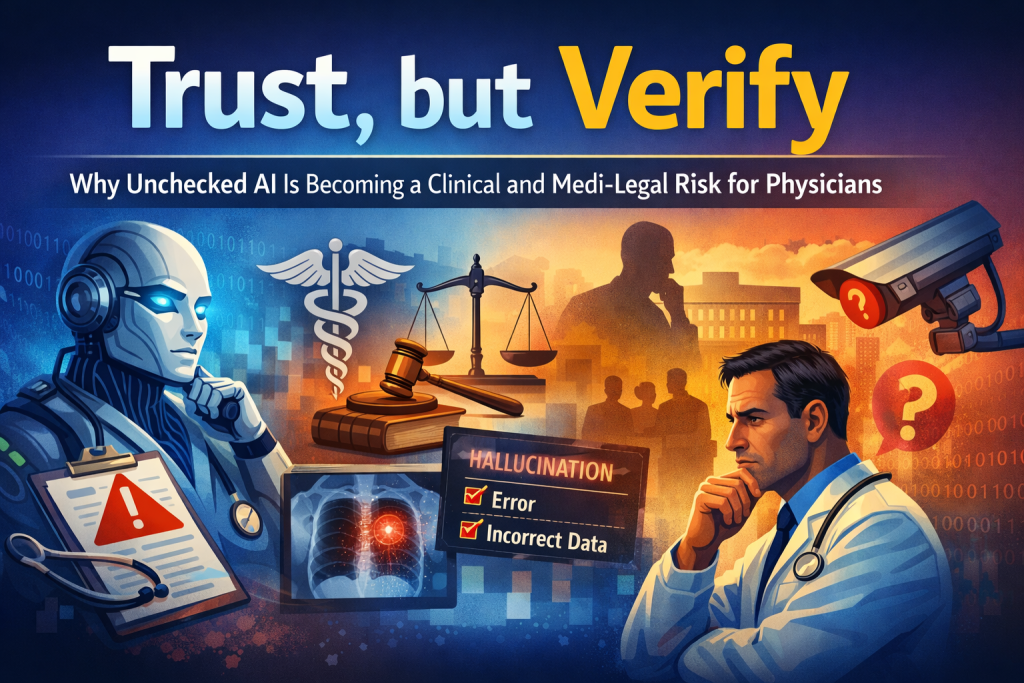
Trust but Verify AI in Personal Injury (PI) and All Medicine
Why Unchecked AI Is Becoming a Clinical and Medi-Legal Risk for Physicians
Let’s talk about artificial intelligence—AI—in PI and medicine overall, especially in the Medi-legal space.
AI is powerful. It’s fast. It saves time.
And right now, it’s also dangerous if you trust it blindly – both as to the specific AI chat platform you are using and the content AI creates.
AI today reminds me of Ronald Reagan’s Cold War mantra when negotiating nuclear disarmament with the Soviet Union: “Trust, but verify.”
Because if you don’t verify, you may be saving time, but you’re taking on risk. And with AI, that risk shows up as hallucinations, errors, and professional landmines that can explode long after the chart is signed or the brief is filed.
We’ve already seen this play out publicly on the legal side. A national law firm was recently hammered by a judge for filing AI-reliant briefs filled with fake citations, misstatements, and unverified research. The judge didn’t mince words, calling the conduct unethical and corrosive to professional trust. In other cases across the country, attorneys have faced fines, sanctions, and even threats to their license for similar misuse.
These warning shots are loud, but are they being heard?
And if we’re being honest, medical offices are next, if they’re not already there.
AI-generated documentation, treatment summaries, diagnosis lists, and causation language can be incredible tools. But they become dangerous the moment they’re accepted without verification. Word substitutions that quietly change a diagnosis. Added language that implies treatment never rendered. Causation statements that overreach, or worse, contradict the clinical facts. These aren’t harmless typos. If relied upon, they can lead to mistreatment, compromised patient care, destroyed credibility, and serious legal exposure.
Danger, danger, danger—if not verified.
Here’s another large misuse and a HIPAA exposure: putting in patient-identified information in AI chatbots that are open to the public. Even some medical offices that use a private chat have staff that inadvertently use a public chat for analysis or language tweaking. Once done, that patient’s private information has been made available to the world. And you thought a misdirected email was bad!
Trust but verify also the AI platform being used by you and your team.
This concern isn’t theoretical. According to the Emergency Care Research Institute (ECRI), an independent, nonpartisan patient safety organization, the misuse of AI chatbots in healthcare has been ranked the number one health technology hazard for 2026. That’s not a fringe opinion. That’s a leading patient safety watchdog sounding the alarm.
ECRI’s report highlights a critical issue: AI chatbots are being widely used by clinicians, staff, and patients even though they are not regulated as medical devices and are not validated for clinical decision-making.
These systems rely on large language models that predict word patterns. They don’t understand medicine. They don’t understand context. They don’t understand risk. But they are programmed to always sound confident and authoritative.
That’s the trap.
ECRI has documented chatbots suggesting incorrect diagnoses, recommending unnecessary testing, promoting substandard medical products, and even inventing anatomy while sounding like a trusted expert. In one example, a chatbot incorrectly advised that placing an electrosurgical return electrode over a patient’s shoulder blade was appropriate. If followed, that advice could have caused serious burns.
The danger isn’t that AI is stupid. The danger is that it sounds smart even when it’s wrong.
And as access to healthcare becomes more strained through rising costs and clinic closures, the temptation to rely on AI as a shortcut will only increase for both patients and providers.
Let me be very clear: this is not an argument against using AI.
You must use it. AI is here to stay. It can improve efficiency, reduce administrative burden, and help practices scale intelligently.
But huge time savings does not excuse professional negligence. Not in your actions—and not in your inactions. And not if you put patient-identified private information in a public AI chat.
AI will not be blamed when something goes wrong. You will.
Medicine and Medi-legal work are fundamentally human endeavors. Algorithms cannot replace education, experience, judgment, or accountability. And when AI-generated content ends up in a medical record, a demand package, or a courtroom exhibit, it carries your name, not the software’s.
The real risk here isn’t AI itself. It’s blind trust.
That’s why ECRI recommends disciplined oversight: educating users on AI’s limitations, always verifying outputs, establishing AI governance committees, providing training, and regularly auditing AI performance. In other words—Trust, but verify.
That concept applied in verifying nuclear disarmament in the 1980s, and it applies to verifying AI input in 2026 and beyond.
And that principle applies just as much in PI as it does in medicine overall.
Use AI to assist. Use it to draft. Use it to organize and summarize. Law firms have expanded their use of AI in PI, and so will medicine. It’s already happened.
Never abdicate your professional responsibility.
Because trust without verification isn’t efficiency, it’s exposure, especially in any Medi-legal setting.
Leverage AI. Embrace it. Stay current with it. Just remember Reagan’s rule when it comes to AI in PI, and in your medical practice as a whole: