
Self-Driving Cars, AI and the Future of Personal Injury
Why The 10-Year PI Death Myth is Wrong, as PI Will Merely Evolve
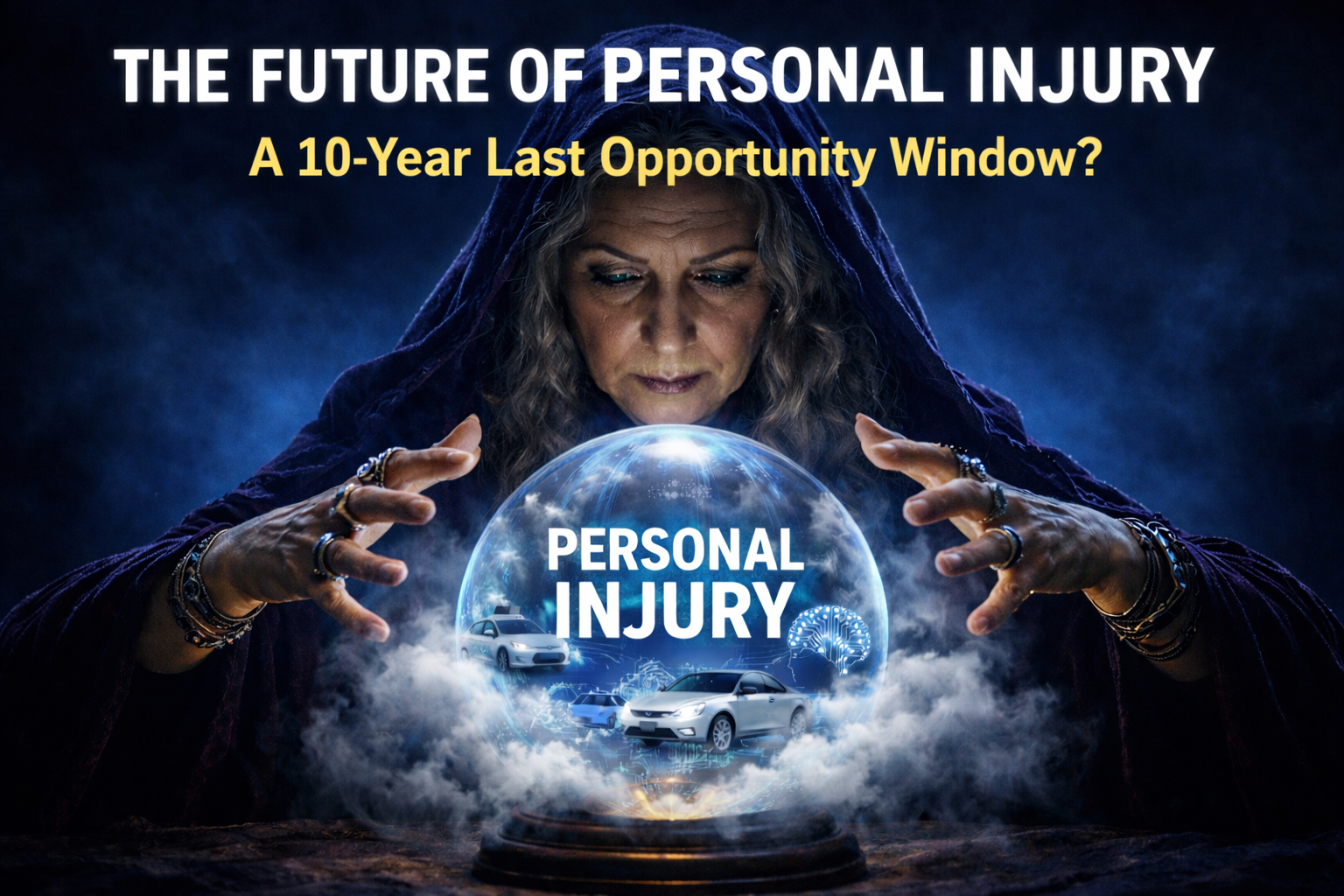
A well-known national personal injury (PI) attorney recently made a bold proclamation.
He said, “Personal Injury has a 10-year window.”
Now statements like that get attention. They’re supposed to. Fear sells. Urgency sells. And nothing rallies a room like telling people the sky is falling, on a deadline.
And the reason given for this prediction? Self-driving cars.
Waymo robotaxis rolling through Phoenix, San Francisco, Los Angeles, Austin, and Atlanta. Autonomous delivery trucks from companies like Gatik and Kodiak. Tesla’s so-called “Full Self-Driving” which ironically, still requires you to pay attention.
So, the logic goes like this: If cars stop crashing…personal injury goes away.
Sounds clean. Sounds logical. Sounds…wrong.
Because history, and human behavior, have a funny habit of refusing to cooperate with clean theories.
The Timeline Problem
Let’s talk reality.
Yes, autonomous vehicles are advancing. Absolutely they are. But there’s a massive difference between technology existing and technology saturating American life.
Most serious projections agree on this:
- Specialized uses—robotaxis, controlled trucking routes, logistics hubs—will expand meaningfully by 2030.
- Broad consumer adoption of true Level 4 or Level 5 autonomy? That’s a different story entirely.
- Many models suggest 2045 before even half of new vehicles sold are autonomous.
- And 2060 or later—25 years from now—before half of the entire U.S. vehicle fleet might be autonomous.
And that’s assuming everything goes right.
Which it never does.
The Barriers Nobody Likes to Talk About
Self-driving cars don’t struggle in TED Talks. They struggle with bad roads, bad weather, construction zones, and human unpredictability.
Then there’s public trust. One high-profile accident doesn’t slow adoption. It freezes it.
Add to that:
- A fragmented regulatory system where states can’t agree on speed limits, let alone autonomy rules
- Massive unanswered legal questions: Who’s liable? Is it the owner, the manufacturer, the software company, the update provider?
- Cybersecurity risks that go far beyond inconvenience. Imagine regional transportation shutdowns or weaponized vehicle hacking disabling or crashing cars
- Infrastructure costs when we still can’t even solve the EV charger station numbers problem
This isn’t a speed bump. It’s a maze.
The One Factor Tech Always Forgets:
American Independence
Here’s the wildcard no algorithm can fully solve.
Americans love independence. In other words, Americans love control.
We love choosing our route.
We love passing slower cars.
We love stopping for coffee on a whim.
We love classic cars, motorcycles, road rallies, and the simple emotional freedom of driving.
Will Americans someday accept being told they can no longer drive? Sure. But not now, and not soon, and not in the next couple of decades.
When that day comes, it won’t be sudden. It will come with a 30-year runway, minimum, when announced by the federal government as a national long-term transition mandate. We aren’t there yet. We aren’t even close.
And here’s the kicker: True national adoption will likely require a new generation. One that has never driven, never taken driver’s ed, never felt the steering wheel as freedom.
That generation hasn’t even been born yet.
So, No—PI Is Not Ending in 10 Years
Put aside the fear.
Will some cities adopt autonomy faster? Absolutely.
Dense, congested, transit-heavy cities like San Francisco, New York, Chicago—places where many people already don’t own cars.
Will trendy, tech-forward cities like Austin adopt earlier? Probably.
But America is vast. Rural. Suburban. Diverse. And deeply personal about mobility.
Now let’s talk about trucks, because this is where the self-driving rubber meets the road.
A fully loaded commercial truck in high winds or icy conditions is already dangerous. Now ask yourself: When will the public fully trust that risk to software—especially with hacking still a threat?
That’s not happening fast.
Eventually? Yes. Soon? No.
Will widespread self-driving eventually reduce accident frequency? Of course.
Will personal injury cases decline when that happens? Yes, significantly.
But not now. Not in 10 years. And likely not even close.
Government never moves as fast as technology. And mass adoption requires government.
So, What Does the Future Look Like?
Let’s start with law.
Tort reform is already sweeping the country. Not because of self-driving cars, but because insurers and corporations fear “nuclear verdicts.”
That pressure won’t disappear. It never does.
But here’s the bigger disruption: Artificial Intelligence.
AI will eliminate the need for attorneys in small PI cases long before self-driving cars ever do.
Why would someone give up 33–45% in fees, plus costs, on a low-value claim when AI can:
- Help select medical providers
- Organize records
- Negotiate with adjusters
That’s the real short-term disruption.
What happens then when you add self-driving vehicles as well?
Fewer true PI experts.
More firms dabbling.
Lower legal quality overall for PI
Now Let’s Talk About Medical Offices—Because This Is the Opportunity
Injuries aren’t going away.
Humans will always find ways to get hurt.
Cars, bikes, scooters, falls, work injuries, sports, aging bodies—injury care is not disappearing.
What will change is where value concentrates.
“All-PI” medical practices tied tightly to law firms will feel pressure, just like “all-PI” law firms.
But that’s a minority.
Most medical offices treat PI as one practice segment, not the whole practice.
And those that develop true PI expertise— documentation, injury causation, impairment, narrative clarity and the healthcare storytelling—will become more valuable, not less.
Here’s the twist most people miss:
As legal expertise declines and AI replaces low-end representation, medical providers, not law firms, will become the backbone of the system.
Medical documentation becomes the case.
Pain, impairment, prognosis—this is where PI case value lives.
The Smart Future for Medical Practices
The future belongs to balanced, forward-thinking practices.
Not “all PI.” But strong PI, perhaps 40% or less, integrated intelligently.
Practices that:
- Understand PI nuances
- Document properly
- Communicate clearly
- Leverage technology without losing clinical authority
Self-driving cars won’t kill personal injury.
AI won’t kill personal injury.
What will disappear is laziness, dependency, lack of real value, and outdated models.
And that’s not a threat.
That’s an opportunity.
Final Thought
Every industry hears the same warning eventually: “You’ve got 10 years left.”
Most of the time that’s not a prophecy, it’s a misunderstanding of how change actually happens.
Personal Injury isn’t dying. It’s evolving.
And the medical practices that evolve with it won’t just survive, they’ll lead.