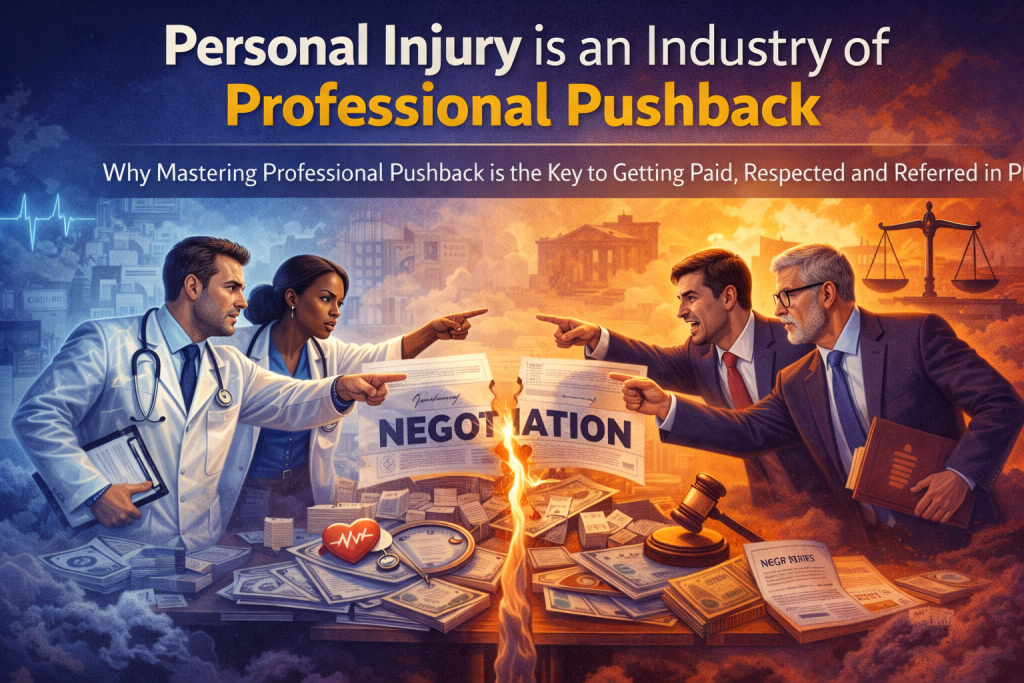
Personal Injury (PI) is an Industry of Professional Pushback
Why Mastering Professional Pushback is the Key to Getting Paid, Respected and Referred in PI
Let’s start with a hard truth about PI negotiations: It’s not conflict that kills deals. It’s how you handle it.
Most medical offices walk away from negotiations with law firms with the same quiet frustration:
“I should have pushed back more.”
“I knew better, but I didn’t say anything.”
“I gave in too fast.”
“I should have realized no difficult attorney has the ability to blackball me in PI.”
That regret isn’t because they lack medical knowledge, experience or good intentions.
It’s because most medical professionals are wired to heal, not to fight.
Personal injury law and the Medi-legal subcomponents within it, are built on conflict.
It’s healers working alongside warriors.
Caregivers negotiating with professionals trained to argue, pressure, and win.
And that contrast is exactly what makes the PI space so misunderstood, yet also so full of opportunity. Because PI is an industry of pushback.
PI is an Industry Grounded in Professional Pushback
Law firms live and breathe conflict. It’s their natural environment.
Every day, attorneys debate insurance adjusters, argue with defense counsel, persuade skeptical judges, manage stressed clients, and navigate opposing narratives. Resistance isn’t something they fear. It’s something they expect.
To attorneys, pushback isn’t personal. It’s professional. It’s a foundation for compensation advocacy.
It’s how value is discovered. It’s how leverage is tested. It’s how compensation is determined.
And it’s how respect is earned.
Medical offices, by contrast, are built on empathy, trust, and care. When conversations get tense, it can feel like a threat to the relationship—or worse, to its reputation.
So many providers retreat.
They soften their language. They discount quietly. They avoid the conversation altogether.
But here’s the truth most offices learn too late: Avoiding conflict doesn’t protect you. It costs you.
Avoiding Disagreement Is Losing by Default
In PI, disagreement is unavoidable.
It’s not a flaw in the system. It’s a feature.
Bills will be questioned. Treatment will be scrutinized. Causation will be challenged. Numbers will be negotiated.
The goal isn’t to escape disagreement. The goal is to collaborate through it.
And that matters because what every medical provider truly wants boils down to two outcomes:
ROI — Return on Investment
Being properly reimbursed for your time, expertise, staff, overhead, and care.
ROR — Return on Relationship
Earning trust, respect, and long-term referrals from patients, peers, and law firms who value your role.
Here’s the counterintuitive reality: Pushback is the path to both.
When handled correctly, disagreement creates clarity. It allows you to explain your medical reasoning, defend your billing, lay out your value-driving role and actions, and demonstrate that your care is thoughtful, defensible, and necessary.
Strong attorneys actually want this.
They don’t need passive providers. They need confident medical partners who can hold their ground because it strengthens their cases, improves settlement value, and protects them at trial.
The Price of Silence
If you can’t articulate your value and support your fees and billing, you’ll always be undervalued.
If you won’t justify your worth, you’ll quietly be placed in the replaceable category.
When law firms sense a provider will fold under pressure, they manage accordingly. That shows up as:
Smaller cases.
Longer payment delays.
More aggressive reductions.
Less urgency when issues arise.
This isn’t malice. It’s management.
In negotiation, perception becomes pricing.
Confidence signals competence. Structure signals strength. Silence signals surrender.
Ironically, many providers avoid pushback because they fear damaging the relationship with that attorney, that law firm, or all firms in the PI space.
But relationships don’t erode from respectful disagreement. They erode from unclear boundaries and a lack of knowledge about PI Medi-legal nuances and leverage points.
Where boundaries are clear and unique PI knowledge is demonstrated, respect follows.
Hope Is Not a Negotiation Strategy
Truth: many providers approach PI negotiations with hope.
They hope for fairness. They hope for integrity. They hope the firm will “do the right thing.”
Hope doesn’t raise reimbursement. Hope doesn’t shorten AR. Hope doesn’t earn leverage.
What you need is not aggression, but a method.
That’s where what I call the Collaborative Clash comes in.
This isn’t about ego, confrontation, or “winning.” It’s about turning tension into traction, conflict into clarity, and pushback into partnership.
The Collaborative Clash with the right method teaches providers how to:
- Listen for leverage instead of reacting emotionally
- Push back without damaging the relationship
- Understand when timing matters more than words
- Assert value without sounding defensive or hostile
- Turn disagreement into data, not drama
When you follow a method, fear is replaced with confidence. Reaction is replaced with control.
You stop bracing for conflict. Instead, you start using it.
Don’t Fool Yourself — You and Your Team Must Be Trained or Outsource to a Pro
Just as it took training and commitment to master your medical skills, the same applies to positioning, protecting, and negotiating for higher pay.
When healers go up against trained warriors—attorneys and law firm staff—you will feel outgunned and outmatched. That’s okay. It’s natural. And it’s fixable.
You have two choices, and you can use either or both:
First, level up the negotiation skills of you and your team so you can control and balance ROI and ROR.
For example, at Personal Injury Made Easy, we teach, train, and support Negotiation Aikido—because getting paid in PI is a contact sport—by learning and applying the DISRUPTIVE Method of lien negotiations.
Second, outsource negotiations to a PI-skilled negotiation professional for law firms that are not optimal long-term partners, in order to maximize ROI with those firms.
If you truly want to elevate profits, do what successful businesses do in the commercial world: bring in the pros. For example, Personal Injury Made Easy offers a negotiation outsourcing service called PI Billing Pros, giving you elite specialists in this unique field to ensure you are treated—and paid—fairly.
From Healer to Partner
The most respected providers in PI aren’t the loudest or the most aggressive.
They’re the clearest.
They know their numbers. They know their documentation. They know their boundaries. They communicate all three calmly and consistently.
And they bring in PI-specific experts to strengthen those skills.
They understand that collaboration doesn’t mean compliance. And professionalism doesn’t mean passivity.
They engage in productive tension.
Because in PI, collaboration without pushback is submission. And pushback without collaboration is chaos.
The magic happens in the middle.
That’s where ROI and ROR intersect. That’s where respect is built. That’s where long-term, profitable PI relationships are formed. And that’s where you come out ahead, even with difficult law firms.
So don’t fear the clash.
Learn to collaborate through it—yourself or with a pro.
Because in PI, it’s not conflict that costs you. It’s failing to approach it strategically and well.