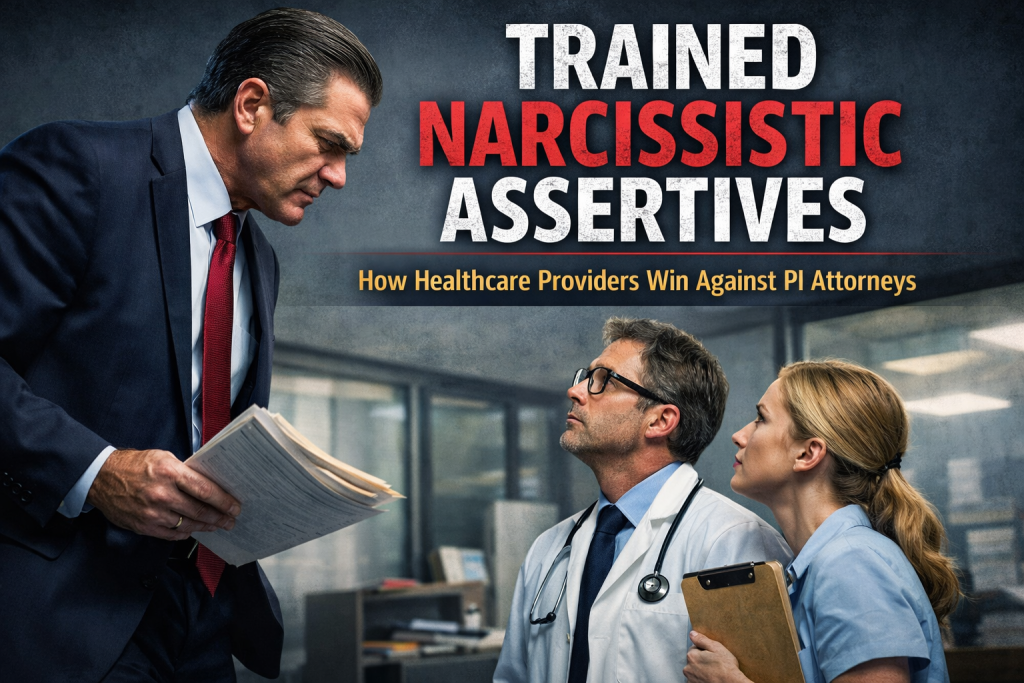
Attorneys are Trained Narcissistic Assertives
How Healthcare Providers Win in the Negotiation-Heavy World of PI
Personal injury attorneys aren’t just trained advocates.
They’re trained narcissistic assertives.
And I don’t say that as an insult. I say it as a reality—one that healthcare providers must clearly understand if they want to succeed in personal injury.
Winning is their primary motivation.
That’s how they’re educated.
That’s how they’re rewarded.
And that’s how their careers advance.
There’s an old joke in the legal world that captures this mindset perfectly.
If the law is against them, they pound on the facts.
If the facts are against them, they pound on the law.
And if both the law and the facts are against them—well…they pound on the table.
And in personal injury, there is a lot of saber rattling and table pounding.
When it comes to healthcare providers, that pressure is aimed at one thing and one thing only:
Reducing what you get paid.
PI attorneys see you, the healer, as easy prey.
Sometimes it’s delivered professionally.
Sometimes it’s delivered politely.
But far too often, it comes in the natural style of the beast you’re dealing with—a trained narcissistic assertive who wants control and victory at all costs.
Their winning. You’re losing.
And don’t get fooled by the idea of a “win-win.”
That’s a comforting phrase—but it’s rarely the reality.
In most PI negotiations, it’s one way or the highway. And if you don’t comply, it’s back to saber rattling and table pounding until you do.
I know this because I was trained as one. I was one.
And when I’m not careful … when I’m not self-aware … I still am one.
That background is exactly why today I negotiate against personal injury attorneys on behalf of healthcare providers. It’s also why I teach doctors and their teams how to out-negotiate law firms as a pro.
And here’s the truth that most providers miss:
In personal injury, the provider often holds far more leverage in this game of business poker than they realize.
The problem isn’t leverage. The problem is visibility.
Most providers don’t know which cards actually matter.
And even when they do, they haven’t been taught how or when to play them.
Instead, they default to something that feels safe but is incredibly costly: Trying to be liked.
Let me be very clear about this.
This is not about being liked.
Being liked makes you vulnerable.
Being liked signals compliance.
Being liked turns you into someone who can be delayed, discounted, or pushed because your desire to be liked becomes leverage against you.
When that happens, you get slotted as a replaceable vendor. Someone the law firm doesn’t feel the need to prioritize.
Someone they won’t put in front of a not-so-nice defense attorney at deposition or trial, because they assume you’ll eventually cave.
Respect is different.
Being respected gets you used more.
Being respected gets you paid more.
Being respected positions you as a professional who can hold their own with calm, confidence, and clarity.
And here’s the part most people don’t expect: Respect actually improves long-term relationships in personal injury.
It creates boundaries.
It creates predictability.
And it creates a healthier dynamic between providers and law firms.
So how do you deal with saber rattling and table pounding?
You don’t match it emotionally.
You don’t try to out-threaten attorneys.
And you don’t shrink back hoping it will stop.
You understand the psychology involved.
You recognize that the pressure isn’t personal, it’s strategic.
It’s designed to wear you down.
To make you second-guess yourself.
To push you into concessions you didn’t need to make.
Then you do something different.
You take control of what actually matters: The negotiation process itself.
You learn how to identify leverage … real leverage.
You learn how to assert it strategically.
And you learn how to do it in a way that’s professional, defensible, and calm.
This isn’t about pounding the table back.
It’s about knowing when to communicate, and when to let silence do the work.
This is the foundation of the negotiation method I teach.
Not aggression. Not appeasement. But intentional control of the process.
When you do this right, something interesting happens.
The saber rattling slows down. The tone changes. The conversation becomes more businesslike.
Not because the attorney suddenly likes you, but because they respect you.
And in personal injury, respect is currency.
If you approach negotiations grounded in strategy, confident in your leverage, and disciplined in your process, you can win in three ways at once.
You win professionally.
You win profitably.
And you win with respect.
Even in the constant pushback world of personal injury.
And even when dealing with trained narcissistic assertives.
That’s not theory. That’s how this game is actually played and how you win it.
Why does this matter?
Because more money means more mission. More healing. More difference-making.
You can take that to the bank.